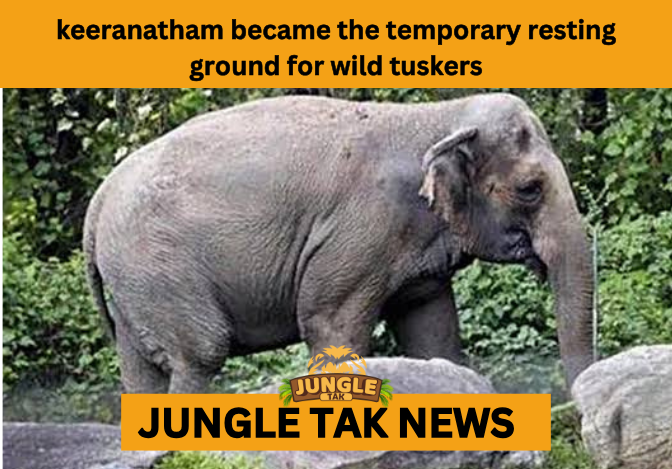

WILD TUSKERS
Coimbatore: In an unprecedented event that has sent ripples of concern through the urban administration and excitement through the local populace, the bustling neighborhood of Keeranatham in Saravanampatti became the temporary resting ground for three WILD TUSKERS. Early Thursday morning, residents who stepped out for their daily routines were greeted not by the usual hum of city traffic, but by the imposing presence of three large elephants—two adults and a sub-adult—roaming dangerously close to the city’s primary Information Technology park. The incident marks a significant escalation in the region’s human-wildlife interactions, bringing the reality of forest encroachment to the doorstep of the digital economy.
The surreal scene unfolded shortly before dawn, around 4:00 AM, when security guards and milk vendors first spotted the massive silhouettes moving silently through the semi-urban landscape. By sunrise, the WILD TUSKERS, seemingly exhausted from a long nocturnal trek, had settled into a pond situated just behind the IT park. The sight of the elephants playfully splashing water and resting in the cool mud provided a stark, almost poetic contrast to the concrete and glass structures of the tech hub looming in the background, drawing hundreds of onlookers to the scene.
The Long Migration
According to detailed assessments provided by the Forest Department, the presence of these WILD TUSKERS in such a densely populated area is the result of a significant detour from their natural habitat. District Forest Officer (DFO) N. Jayaraj confirmed that the animals are believed to have wandered out of the Periyanaickenpalayam forest range, a critical habitat that has seen increasing fragmentation. It is estimated that the herd traversed nearly 40 kilometers, navigating through a mosaic of farmlands and smaller settlements before breaching the city limits.
The route taken by the WILD TUSKERS highlights the perilous journey wildlife must undertake when traditional corridors are obstructed. Officials suspect that the animals likely followed the course of the Kousika River, a natural drainage line that often acts as a makeshift corridor for fauna. Having crossed the busy Coimbatore-Mettupalayam National Highway—likely during the dead of night when traffic was minimal—the elephants continued eastward, eventually losing their bearings and ending up in the cul-de-sac of Keeranatham’s residential zone.
Strategic Containment and Rescue
Upon receiving frantic alerts from the local administration and concerned residents, the Coimbatore Forest Department launched a high-priority rescue operation to manage the WILD TUSKERS. The situation presented a logistical nightmare: driving elephants out of a forest is standard procedure, but guiding them through a labyrinth of streets, houses, and inquisitive crowds requires surgical precision. A specialized task force was immediately assembled, comprising the region’s most experienced trackers and veterinarians.
To ensure the safety of both the public and the animals, the department deployed four special teams dedicated to monitoring the every move of the WILD TUSKERS. These teams, equipped with wireless communication sets and crackers, established a perimeter around the pond. Their primary directive was to contain the animals in the open water body during the day, preventing them from wandering into the narrow residential bylanes where the risk of property damage and human injury would skyrocket.
Technology played a crucial role in this urban wildlife operation. The Forest Department utilized thermal imaging drones to keep a constant eye on the WILD TUSKERS within the thickets surrounding the pond. This aerial surveillance allowed officials to track the herd’s stress levels and formation without physical intrusion, ensuring that the animals remained relatively calm despite the alien environment they found themselves in.
The Human Challenge
However, the operation faced a significant hurdle not from the animals, but from the public. As news of the WILD TUSKERS spread via social media, crowds began to swell around the perimeter. The curiosity to capture selfies and videos of the rare urban visitors posed a severe risk. Forest staff and local police had to work tirelessly to push back spectators, warning that any sudden noise or agitation could provoke the stressed animals into a charge, turning a peaceful sighting into a tragedy.
The incident has reignited the debate surrounding the ecological pressures facing the Coimbatore Forest Division. Conservationists point out that the straying of WILD TUSKERS is not an act of aggression but a symptom of habitat loss. The blockage of the Thadagam Valley corridors and the expansion of brick kilns and institutions into the forest fringes have severed the ancient migratory paths, forcing herds to explore new, riskier routes that inevitably lead them into human habitations.
A Pattern of Displacement
Data from the forest department indicates that this is not an isolated event, though the depth of the intrusion is rare. In recent months, WILD TUSKERS have been recorded straying out of the reserve forests in the district with alarming frequency. Each incident serves as a grim reminder that the buffer zones separating the Western Ghats’ biodiversity from Coimbatore’s rapid infrastructural growth are vanishing, leaving the animals with no “right of passage.”
CONTINUE READING WITH JUNGLETAK – INDIA ECOSYSTEM
As the sun began to set, the Forest Department prepared for the most critical phase of the operation: the drive back. With traffic on the main roads halted and electricity in the immediate vicinity temporarily disconnected for safety, the teams positioned themselves to guide the WILD TUSKERS back toward the Kurudampalayam reserve. The plan involved a coordinated effort to steer the giants silently through the dark, retracing their steps back to the safety of the Periyanaickenpalayam range.
For the residents of Keeranatham, the day will be remembered as the time the wild came to the city. But for the forest officials and conservationists, the plight of these three WILD TUSKERS underscores an urgent need for better land-use planning and corridor restoration to ensure that such magnificent creatures do not become refugees in their own land.