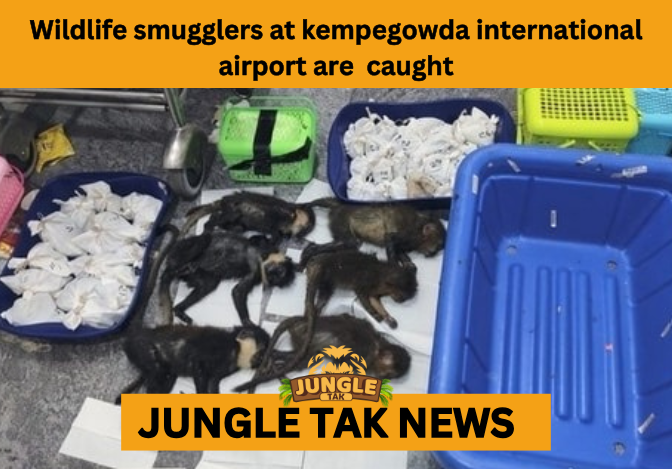

WILDLIFE SMUGGLING in BENGALURU: The vigilance of Customs officials at the Kempegowda International Airport (KIA) has once again thwarted a brazen attempt to traffic live animals into India. On Wednesday night, officials intercepted a male passenger arriving from Bangkok who was attempting to transport several rare primates concealed within his checked-in luggage. The incident has sent shockwaves through the conservation community and highlighted the growing sophistication of WILDLIFE SMUGGLING networks that are increasingly viewing Bengaluru as a lucrative transit point and destination for exotic pets.
The passenger, whose identity has been withheld pending further investigation, arrived on a flight from Thailand, a known hub for the illegal wildlife trade. According to Customs sources, the individual was intercepted based on specific intelligence and profiling. While his behavior initially appeared normal, discrepancies in his travel history and the unusual density of his baggage during the X-ray screening raised red flags.
Upon opening the suitcases, officials were met with a distressing sight. Stuffed inside ventilated plastic crates hidden between layers of clothing were live primates. Preliminary identification suggests the animals include Pygmy Marmosets—the world’s smallest monkeys—and Dusky Leaf Monkeys, both of which are protected species under international conventions. The condition of the animals was described as “stressed and dehydrated,” a common consequence of the brutal conditions associated with WILDLIFE SMUGGLING where profit is prioritized over the survival of the creatures.
The Modus Operandi and Seizure
The operation, carried out by the Air Intelligence Unit (AIU) of Bengaluru Customs, underscores the evolving tactics of traffickers. In the past, smugglers often used hand baggage or concealed smaller animals on their person. However, placing live primates in checked luggage exposes the animals to freezing temperatures and lack of pressurization, significantly increasing the mortality risk.
“The brutality of this specific case of WILDLIFE SMUGGLING is appalling,” stated a senior Customs official involved in the seizure. “The animals were sedated to prevent them from making noise, which is a standard tactic used to evade detection. Had the flight been delayed or the baggage handling been rougher, these animals would likely have arrived dead.”
The officials immediately alerted the Karnataka Forest Department and the Animal Quarantine and Certification Services (AQCS). Under the strict protocols of the Customs Act, 1962 and the Wild Life (Protection) Act, 1972, the animals cannot be released into Indian territory due to the risk of introducing zoonotic diseases. They are currently being stabilized by veterinary experts and will be deported back to their country of origin, Thailand, on the next available flight.
Bengaluru: A Growing Hub for WILDLIFE SMUGGLING Syndicates
This incident is not an anomaly but part of a disturbing upward trend. Over the last three years, Kempegowda International Airport has seen a spike in seizures involving exotic species, ranging from kangaroos and ball pythons to iguanas and rare birds. The demand is driven by wealthy collectors and “pet lovers” in Bengaluru and neighboring cities who desire status symbols regardless of the ethical or legal cost.
The allure of WILDLIFE SMUGGLING is fueled by the massive profit margins. A pair of Pygmy Marmosets can fetch upwards of ₹5 to ₹8 lakh in the domestic black market. This high demand incentivizes couriers, often “mules” paid a fraction of the profit, to take the risk. “Bengaluru’s connectivity to Southeast Asia, particularly Malaysia, Thailand, and Singapore, makes it a preferred route. We are seeing a shift from Chennai to Bengaluru as smugglers attempt to test different airports,” a Wildlife Crime Control Bureau (WCCB) expert explained.
The investigation into this latest case is now focusing on the receiver. Customs officials are analyzing the passenger’s call records and contacts to dismantle the local network facilitating this WILDLIFE SMUGGLING racket. Authorities believe that the passenger was merely a courier and that a larger syndicate operating within Karnataka is responsible for placing the order.
Legal Consequences and Health Risks
The arrested passenger has been booked under relevant sections of the Customs Act. While the Wildlife Protection Act primarily covers indigenous species, recent amendments and India’s commitment to CITES (Convention on International Trade in Endangered Species of Wild Fauna and Flora) ensure that trafficking non-native species is also a punishable offense.
Beyond the legalities, the health implications of WILDLIFE SMUGGLING are severe. Primates are genetically close to humans and can carry dangerous pathogens, including Herpes B virus, Monkeypox, and various hemorrhagic fevers. Smuggling them without quarantine checks bypasses the biological firewalls meant to protect the country’s ecosystem and public health. “Every time an animal is smuggled in, we are rolling the dice on a potential new epidemic,” warned a veterinary officer at the airport.
CONTINUE READING WITH JUNGLETAK – Elephant herd
Conclusion
As the rescued primates await their repatriation to Thailand, the incident at KIA serves as a grim reminder of the scale of the global wildlife trade. While the swift action of the Bengaluru Customs is commendable, the continued demand for exotic pets ensures that the supply chains remain active.
Ending the scourge of WILDLIFE SMUGGLING requires not just vigilance at airports but a crackdown on the domestic markets and social media platforms where these animals are openly traded. Until the buyers are held accountable, the silent suffering of these animals in the cargo holds of airplanes will continue. The passenger remains in judicial custody as the investigation deepens to identify the kingpins behind this cruel enterprise.