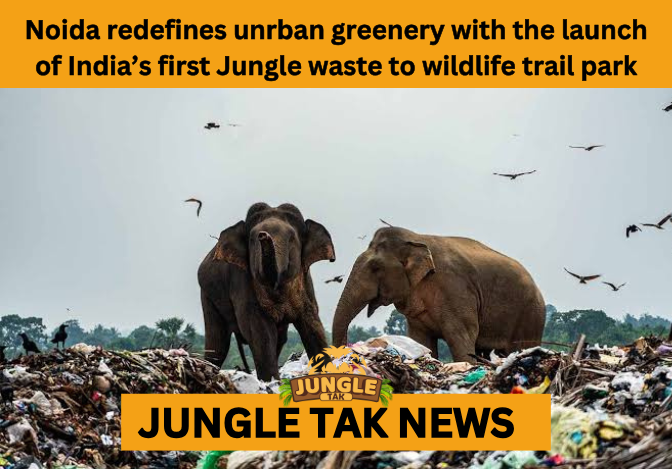

Waste to Wildlife: NOIDA — In a visionary leap for sustainable urban planning, the Noida Authority has unveiled a spectacular fusion of art, nature, and recycling with the inauguration of the Jungle Trail Park in Sector 94. Celebrated as India’s premiere Waste-to-Wildlife destination, the sprawling facility has rapidly become the talk of the National Capital Region, offering a tangible demonstration of how urban refuse can be reimagined into a world-class attraction.
Situated strategically near the Mahamaya Flyover and the Okhla Bird Sanctuary, the park represents a significant departure from traditional recreational spaces. Instead of concrete structures or imported statues, visitors are welcomed by a surreal mechanical menagerie. The core philosophy of the park revolves around the Waste-to-Wildlife concept, a testament to the potential of the circular economy where discarded materials are given a second, artistic life.
The visual narrative of the park is driven by its staggering collection of over 600 life-sized sculptures. Walking through the gates, one is immediately struck by the ingenuity required to forge these beasts. Approximately 500 tonnes of metal scrap—ranging from rusted iron rods and clutch plates to hefty gearboxes and automobile chains—have been salvaged from government stores and construction sites to create these installations. The result is a steampunk-inspired safari where the muscular curve of a panther is mimicked by bent rebar, and the feathers of an owl are crafted from meticulously layered sheet metal.
However, the Waste-to-Wildlife initiative is not solely about metallic art; it is equally committed to ecological restoration. The park serves as a vital green lung for the city, utilizing the Miyawaki method of afforestation. This technique has allowed for the planting of thousands of native trees and shrubs that grow rapidly and densely, creating a carbon sink that offsets the urban pollution of the surrounding highway. The lush greenery softens the harsh aesthetics of the scrap metal, creating a harmonious balance between the industrial and the organic.
The visitor experience is further enhanced by thoughtful amenities designed to make the park a cultural hub. A grand open-air amphitheater sits at the heart of the complex, intended for environmental workshops, school excursions, and cultural performances. As daylight fades, the park transforms yet again. A sophisticated lighting system illuminates the sculptures, casting dramatic shadows and highlighting the texture of the recycled materials, effectively turning the Waste-to-Wildlife park into an immersive night safari.
Waste to Wildlife : Noida Unveils the Jungle Trail A Monument to Sustainable Innovation
NOIDA — In a defining moment for India’s urban development and environmental consciousness, the Noida Authority has officially opened the gates to the Jungle Trail Park, a groundbreaking project that stands as the country’s first dedicated Waste to Wildlife destination. Located in the bustling Sector 94, adjacent to the Mahamaya Flyover and the serene Okhla Bird Sanctuary, this ambitious venture has successfully reimagined the potential of urban refuse, turning a discarded landscape into a vibrant hub of art and ecology.
The park’s inauguration marks a significant shift in how public spaces are conceived in the National Capital Region. At the heart of this transformation is the Waste to Wildlife philosophy, a concept that challenges the linear “take-make-dispose” model of consumption. Instead, the park serves as a living testament to the circular economy, where approximately 500 tonnes of heavy industrial scrap—salvaged from government stores, construction sites, and automotive dumps—have been meticulously repurposed. Visitors entering the park are not greeted by traditional bronze statues or caged animals, but by a breathtaking mechanical menagerie that proves even the most rusted debris can be forged into beauty.
The artistic execution within the park is nothing short of engineering wizardry. The sprawling landscape features over 600 life-sized sculptures that mimic the natural world with uncanny precision. The Waste to Wildlife theme is evident in every detail: the sinewy muscles of a stalking leopard are crafted from bicycle chains and clutch plates, while the towering legs of a giraffe utilize discarded iron pipes and streetlamp poles. This “steampunk” aesthetic offers a unique visual language, allowing visitors to view familiar creatures through a lens of industrial innovation.
Designed to offer an immersive narrative rather than a disjointed collection of art, the park guides guests on a seamless journey across the globe. The experience flows through distinct geographical zones, beginning with the grand scale of the African Savannah, moving through the dense foliage of the Asian Jungle, and traversing the unique biodiversity of the Australian Outback. The creativity reaches its peak in the Aquatic and Polar zones, where heavy metal defies gravity to depict weightless marine life and polar bears, further emphasizing the versatility of the Waste to Wildlife medium.
Beyond the metallic spectacles, the park addresses the critical need for urban green spaces. The project integrates the Miyawaki method of afforestation, enveloping the metal sculptures in a rapidly growing, dense native forest. This juxtaposition of cold industrial metal against lush, thriving vegetation reinforces the core message of the Waste to Wildlife campaign: that technology and nature must find a way to coexist. The green cover acts as a carbon sink for the city, filtering pollutants and providing a natural habitat for real birds and insects that complement their mechanical counterparts.
The facility is also equipped to serve as a cultural and educational center. A spacious open-air amphitheater has been constructed to host environmental workshops and cultural events, fostering a deeper community engagement with the principles of sustainability. As evening falls, the park undergoes a dramatic transformation; a specialized lighting system illuminates the sculptures, creating a “Night Safari” that highlights the textures of the recycled materials and offers a hauntingly beautiful perspective on the Waste to Wildlife concept.
Continue reading – Waste to Wildlife
With an affordable entry fee designed to ensure inclusivity, the Jungle Trail Park is more than just a tourist attraction; it is a bold statement of intent. It demonstrates to cities across India that waste management can be creative, beautiful, and profitable. By successfully converting hundreds of tonnes of scrap into a world-class destination, Noida has provided a blueprint for the future, proving that the journey from Waste to Wildlife is not just an ideal, but a tangible reality.