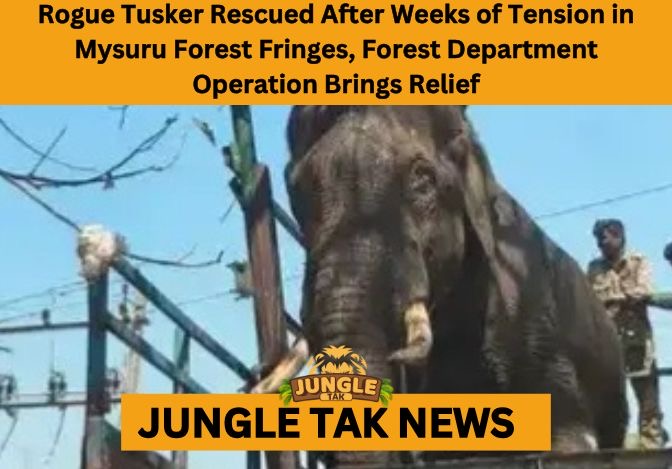

The tension that has gripped the villages bordering the Mysuru forest divisions for the past several weeks has finally dissipated following a high-stakes intervention. Residents of the Hunsur and HD Kote taluks can now breathe a sigh of relief after the successful completion of the Mysuru rogue tusker rescue operation. The wild elephant, which had become a significant threat to both life and property, was darted and safely secured by a specialized team of forest officials and veterinarians.
For nearly a month, the lone bull elephant had strayed from the protected areas of the Nagarahole and Bandipur regions, venturing deep into human settlements. This escalating conflict necessitated the Mysuru rogue tusker rescue operation, as the animal had grown increasingly aggressive, damaging hectares of agricultural land and causing several close encounters with local farmers. The forest department had been monitoring the animal’s movements via drones for days before giving the final go-ahead for the capture.
The Strategic Execution of the Mission
The logistics involved in such a massive undertaking were immense, requiring the coordination of over 60 forest personnel and a fleet of specialized vehicles. At the heart of the Mysuru rogue tusker rescue operation was the deployment of “Kumki” elephants—trained captive elephants used to corner and calm their wild counterparts. These majestic helpers played a vital role in navigating the thick lantana bushes where the rogue tusker had been seeking refuge during the daylight hours.
Field officers reported that the terrain made the initial phases of the mission extremely difficult. The thick undergrowth often obscured the target, making it dangerous for the ground teams to approach on foot. However, the lead veterinarian managed to find a clear window to fire a tranquilizer dart, a critical turning point in the Mysuru rogue tusker rescue operation. Once the sedative took effect, the team moved in quickly to ensure the elephant remained stable and hydrated during the transition.
Addressing the Root of Human-Wildlife Conflict
The frequency of elephants straying into Mysuru’s fringes has become a growing concern for wildlife biologists and the state government. This latest Mysuru rogue tusker rescue operation serves as a stark reminder of the shrinking corridors and habitat fragmentation that drive these magnificent creatures toward human habitation. While the immediate threat has been neutralized, experts argue that such rescues are only temporary fixes to a much larger environmental challenge.
Local villagers, who have spent sleepless nights guarding their ginger and banana plantations, expressed their gratitude toward the forest department. For them, the Mysuru rogue tusker rescue operation was not just a wildlife management task; it was a matter of survival. The elephant had reportedly lost its fear of traditional deterrents like firecrackers and drums, making the professional intervention the only viable way to prevent a potential loss of human life.
The Climax: A Tense Capture and Relocation
Once the rogue tusker was sedated, the most physically demanding part of the mission began. Using heavy-duty cranes and the physical guidance of the Kumki elephants, the unconscious giant was hoisted onto a specially designed truck. This phase of the Mysuru rogue tusker rescue operation required precision to ensure the elephant’s trunk remained unobstructed, allowing it to breathe freely while being transported to a high-security elephant camp for observation.
Crowds gathered at a safe distance to witness the departure of the animal that had dominated their lives for weeks. Despite the previous animosity caused by crop raids, there was a sense of somber respect as the tusker was driven away. The success of the Mysuru rogue tusker rescue operation is a testament to the skill of the Karnataka Forest Department, which is often cited as one of the most experienced teams in India for handling such delicate operations.
Ensuring Long-Term Safety and Monitoring
The elephant has now been moved to a forest camp where it will be fitted with a radio collar before being released back into a deeper, more remote part of the sanctuary. This post-rescue tracking is a fundamental part of the Mysuru rogue tusker rescue operation, as it allows officials to monitor if the animal attempts to return to the forest fringes. The data gathered from the collar will also help scientists understand the migration patterns that led the tusker into conflict zones in the first place.
In the coming weeks, the forest department plans to strengthen the elephant-proof trenches (EPT) and solar fencing in the areas affected by the tusker’s presence. These preventative measures, combined with the successful Mysuru rogue tusker rescue operation, aim to create a more sustainable boundary between the wild and the suburban. Local leaders are also calling for faster compensation for the farmers whose livelihoods were destroyed during the elephant’s month-long foray.
CONTINUE READING WITH JUNGLETAK – AI INNOVATION: SMART SOLAR SCARECROWS
A Lesson in Coexistence
The safe conclusion of this event marks a victory for both the people of Mysuru and the cause of wildlife conservation. While the Mysuru rogue tusker rescue operation has restored order to the region, it highlights the need for ongoing vigilance and smarter land-use policies. By treating the animal with care rather than resorting to lethal force, the department has shown that even the most tense conflicts can be resolved through professional expertise.
As the forest returns to its natural rhythm, the story of the rogue tusker will remain a cautionary tale about the delicate balance of nature. The Mysuru rogue tusker rescue operation has successfully protected a valuable member of an endangered species while ensuring that the humans living on the edge of the forest can once again sleep without fear. Continued investment in such specialized teams will be crucial as India navigates the complex realities of sharing space with its wild heritage.