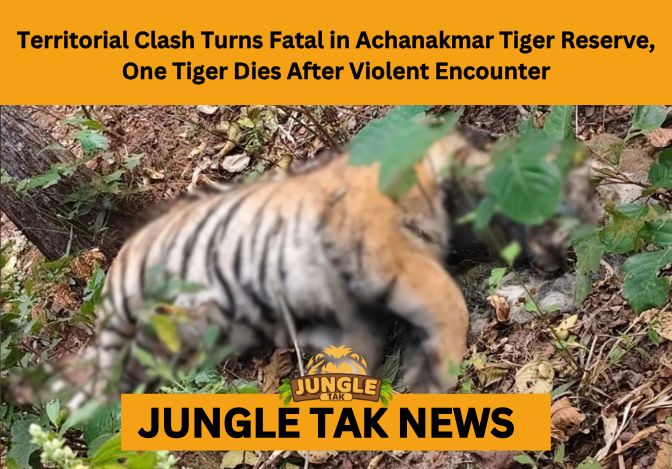

The primordial silence of the Achanakmar Tiger Reserve (ATR) in Chhattisgarh was shattered this week by a grim discovery that highlights the brutal reality of the wild. Following reports of a missing male tiger from regular patrol routes, forest officials located the carcass of a mature male in the Lormi forest range. Preliminary investigations and a detailed necropsy have confirmed that the animal succumbed to injuries sustained during a fatal tiger clash in Achanakmar, an event that underscores the intense competition for territory within the reserve’s core area.
The Discovery in the Lormi Forest Range
The incident came to light during a routine beat patrol when frontline staff noticed an unusual gathering of scavengers near a dense thicket in the Lormi range. Upon closer inspection, they found the remains of a male tiger, approximately 7 to 8 years old, bearing signs of a violent struggle. This fatal tiger clash in Achanakmar appears to have taken place under the cover of darkness, where two apex predators engaged in a high-stakes battle for dominance over a shared hunting ground and mating rights.

Post-Mortem Findings Point to Violent Struggle
A team of forensic experts and wildlife veterinarians conducted a thorough post-mortem examination in accordance with the National Tiger Conservation Authority (NTCA) guidelines. The autopsy revealed deep puncture wounds on the neck, shoulders, and skull, consistent with the canine marks of another large tiger. The sheer force of the impact and the nature of the injuries left no doubt that a fatal tiger clash in Achanakmar was the primary cause of death, ruling out any immediate suspicion of poaching or poisoning.
Survival of the Fittest: Understanding Territoriality
In the world of the Royal Bengal Tiger, territory is everything. A male tiger requires an expansive home range to ensure an adequate prey base and access to females. When these ranges overlap, conflict becomes inevitable. Experts suggest that the fatal tiger clash in Achanakmar is a classic example of “intraspecific competition,” where a younger, stronger challenger likely attempted to oust the resident male. In the dense canopy of Achanakmar, such battles are a natural, albeit tragic, mechanism of population regulation and genetic selection.
The Rising Density of Achanakmar Tiger Reserve
Over the last few years, Achanakmar has seen a steady, albeit cautious, rise in its tiger population due to enhanced protection and habitat management. While this is a conservation success story, it also leads to “space crunch” within the core zones. As the number of tigers increases, the frequency of a fatal tiger clash in Achanakmar may also rise, as the available “prime real estate” becomes limited. This incident serves as a reminder that habitat quality and the availability of corridors are just as important as the absolute number of tigers.
Identifying the “Winner” Through Camera Traps
While the reserve mourns the loss of a majestic predator, the forest department is now working to identify the survivor of the encounter. Camera trap data from the Lormi and Bijadandi ranges are being meticulously analyzed to spot a tiger with fresh battle scars. Identifying the victor of this fatal tiger clash in Achanakmar is crucial for management purposes, as it helps officials understand the shifting territorial boundaries and the health of the remaining tiger population in that specific sector.
Adherence to NTCA Standard Operating Procedures
To maintain transparency and ensure no foul play was involved, the entire process—from the recovery of the carcass to the final cremation—was documented on video. Representatives from the NTCA and local wildlife NGOs were present during the proceedings. By strictly following the SOPs, the administration has confirmed that this fatal tiger clash in Achanakmar was a purely natural event, reflecting the “law of the jungle” rather than a failure of security or human-induced threat.
Impact on the Local Ecosystem
The loss of a dominant male can lead to a period of instability within the local ecosystem. When a resident male is killed in a fatal tiger clash in Achanakmar, it often triggers a “succession crisis” where other transient males move in to claim the vacant territory. This can sometimes lead to further infanticide or additional clashes until a new social hierarchy is established. Wildlife biologists will be monitoring the Lormi range closely over the next few months to observe how the local tiger dynamics stabilize.
Corridor Connectivity and Conflict Mitigation
One of the long-term solutions to reducing the frequency of a fatal tiger clash in Achanakmar is the strengthening of wildlife corridors. If tigers have safe passage to migrate to other nearby forests, such as the Kanha-Achanakmar corridor, the pressure on the core area is significantly reduced. This fatal encounter highlights the urgent need for landscape-level conservation strategies that allow younger males to disperse and establish territories in adjacent forest divisions without being forced into a fight to the death.
The Role of Prey Base in Predator Conflict
A contributing factor to territorial aggression is the density of prey. In areas where spotted deer and sambar are concentrated, tigers will fight more fiercely to keep their “pantry” protected. Following the fatal tiger clash in Achanakmar, the forest department is reviewing its habitat enrichment programs. By spreading the prey base more evenly across the reserve, officials hope to reduce the “clustering” of tigers in specific pockets, thereby lowering the chances of lethal encounters between competing males.
Security and Anti-Poaching Vigilance
Even though this death was natural, the incident has prompted an increase in patrolling across the reserve. The presence of a carcass, even from a fatal tiger clash in Achanakmar, can sometimes attract opportunistic poachers or lead to retaliatory actions if the conflict spills into human-dominated landscapes. The ATR management has deployed additional “tiger protection force” units to ensure that the remaining tigers are safe during this period of territorial transition.
Community Awareness in the Buffer Zone
The villagers living in the fringes of the Achanakmar Tiger Reserve have been sensitized about the recent event. While a fatal tiger clash in Achanakmar is a natural process, the aggression of the surviving tiger may be heightened for several days following the fight. Residents have been advised to avoid entering the deep forest for cattle grazing or firewood collection, as the resident predators may be more territorial and prone to defensive aggression while they heal from their wounds.
CONTINUE READING WITH JUNGLETAK – SUPER CUBED SIZED SHREW
A Somber Reminder of Nature’s Law
In the end, the death of the male tiger in the Lormi range is a somber reminder that nature is both beautiful and redoubtable. While conservationists work tirelessly to protect these animals from external threats like poaching, they remain subject to the ancient and unforgiving rules of their own species. The fatal tiger clash in Achanakmar is a testament to the wildness of the reserve—a place where life is fought for, and where the death of one king paves the way for the reign of another. As the sun sets over the Sal forests of Achanakmar, the cycle of life continues, governed by the strength, stealth, and survival of India’s most iconic predator.