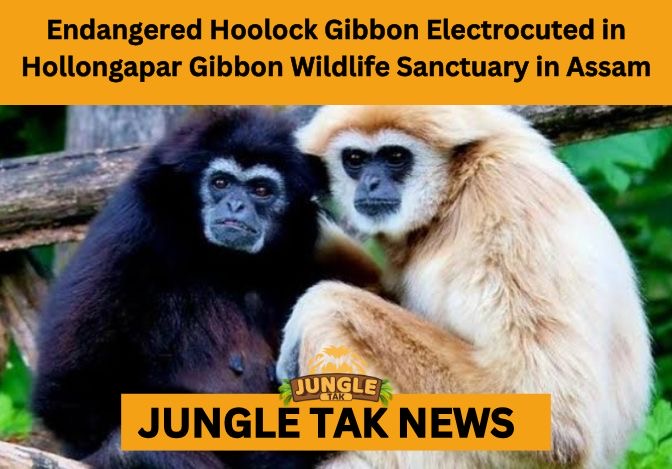

The serene canopy of the Hollongapar Gibbon Wildlife Sanctuary in Assam has been struck by a preventable tragedy, sparking fresh outrage among wildlife enthusiasts and environmentalists. A male Western Hoolock Gibbon, a species already teetering on the edge of extinction, was found dead after coming into contact with a high-tension power line. This recent Hoolock Gibbon electrocution in Hollongapar highlights the persistent threat that uninsulated electrical infrastructure poses to the arboreal inhabitants of this unique ecosystem.
The incident took place in the Jorhat district of Assam, a region celebrated for its rich biodiversity but increasingly marred by habitat fragmentation. Local forest officials confirmed that the primate was killed instantly when it swung onto an overhead wire passing through the sanctuary’s buffer zone. News of the Hoolock Gibbon electrocution in Hollongapar has reignited the long-standing debate regarding the safety of wildlife living in proximity to human-engineered hazards, especially in protected forest patches.
The Vulnerability of India’s Only Ape
The Western Hoolock Gibbon is the only ape species found in India, and its survival is intrinsically linked to the dense, continuous canopies of Northeast India. Because these primates are strictly arboreal, they rarely descend to the ground, relying on tree branches to move, forage, and socialize. When their natural pathways are interrupted by power lines, the result is often a fatal Hoolock Gibbol electrocution in Hollongapar, as the animals mistake the wires for sturdy vines or branches during their transit through the forest.
Hollongapar Gibbon Wildlife Sanctuary is a relatively small, isolated pocket of forest surrounded by tea plantations and human settlements. This isolation forces the gibbons into closer contact with civil infrastructure, significantly increasing the risk of a Hoolock Gibbon electrocution in Hollongapar. Environmentalists have long argued that the peculiar geography of this sanctuary requires specialized protection measures that differ from larger, more contiguous national parks.
A Recurring Threat to Assam’s Biodiversity
This is not the first time that the state has witnessed such a heartbreaking loss. Over the years, several primates and even elephants have fallen victim to poorly maintained or low-hanging electrical wires across the state. The frequency of Hoolock Gibbon electrocution in Hollongapar suggests a systemic failure in coordinating wildlife safety with rural electrification efforts. Despite numerous pleas from the Forest Department, the insulation of wires remains a slow and incomplete process.
Experts suggest that the high-voltage lines cutting through the sanctuary serve as “death traps” for the primates. The physical structure of these lines is often hidden by the lush foliage, making it impossible for the animals to distinguish between a safe branch and a lethal conductor. Every instance of Hoolock Gibbon electrocution in Hollongapar represents a massive blow to the genetic diversity of a species that is already classified as Endangered on the IUCN Red List.
The Failure of Infrastructure Mitigation
For years, conservationists have demanded that power lines within and around sensitive wildlife zones be shifted underground or heavily insulated. However, bureaucratic hurdles and funding issues have often delayed these essential upgrades, leading to another Hoolock Gibbon electrocution in Hollongapar. While the Assam Power Distribution Company Limited (APDCL) has been alerted multiple times, the pace of implementation has not matched the urgency required to protect these rare apes.
Beyond insulation, the lack of “canopy bridges”—artificial crossings that allow gibbons to cross gaps safely—has contributed to the high rate of Hoolock Gibbon electrocution in Hollongapar. In the absence of natural corridors, the gibbons take risks that lead them directly into the path of live currents. The death of this male gibbon is a stark reminder that without physical barriers or safer infrastructure, the sanctuary is no longer a “sanctuary” in the truest sense of the word.
Calls for Immediate Accountability and Action
In the wake of this latest Hoolock Gibbon electrocution in Hollongapar, local NGOs and wildlife activists are calling for a high-level inquiry into the negligence of the power department. There is a growing demand for the immediate decommissioning of overhead lines that pass through the core areas of the sanctuary. Activists argue that the cost of moving these lines is negligible compared to the permanent loss of a species that is a pride of Assam’s natural heritage.
The Forest Department has registered a case and is investigating the specific circumstances of the Hoolock Gibbon electrocution in Hollongapar. While an autopsy will provide the formal cause of death, the visual evidence of charred limbs and the proximity to the wire leaves little room for doubt. Conservationists are now pushing for a mandatory “wildlife impact assessment” for all electrical projects near protected areas to prevent such tragedies from recurring.
CONTINUE READING WITH JUNGLETAK – TRAGIC ENCOUNTER: HUMAN ELEPHANT CONFLICT
A Wake-Up Call for Conservation
The loss of an endangered ape is more than just a local news story; it is a global conservation setback. The Hoolock Gibbon electrocution in Hollongapar serves as a grim warning that human development cannot continue at the expense of the natural world. If we cannot protect a small, isolated population of apes in a designated wildlife sanctuary, the future of India’s broader biodiversity remains in serious jeopardy.
To honor the memory of the lost gibbon, the authorities must move beyond rhetoric and take concrete steps to secure the forest. Immediate insulation of all wires and the construction of rope bridges are the only ways to ensure that we never have to report on a Hoolock Gibbon electrocution in Hollongapar ever again. The eyes of the world are on Assam, waiting to see if the state will prioritize its unique wildlife over convenient infrastructure.