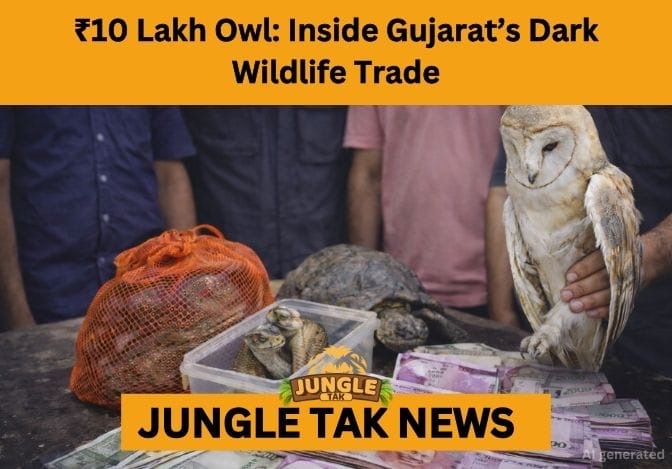

Underground Market of Gujarat’s Dark Wildlife Trade
In the quiet corners of Gujarat’s dense forests and urban fringes, a silent and sinister economy thrives. Recent investigative reports and forest department crackdowns have revealed a shocking reality: the Indian Eagle-owl and the Barn owl are being sold for prices as high as ₹10 lakh. This astronomical figure is not for the bird’s ecological value, but for its perceived role in occult rituals, marking a disturbing peak in Gujarat’s dark wildlife trade.
The High Price of Superstition
The demand for these nocturnal raptors typically surges during specific lunar cycles and festivals like Diwali. It is believed by some that sacrificing an owl, the “vahan” (vehicle) of Goddess Lakshmi, will bring immense wealth and trap the goddess of fortune within the practitioner’s home. This archaic and brutal belief system provides the primary financial oxygen to Gujarat’s dark wildlife trade, turning a majestic predator of the night into a mere commodity for the superstitious elite.

Recent Seizures and the Modus Operandi
State enforcement agencies have recently intercepted several consignments where owls were found cramped in tiny cages, their talons clipped and eyes stitched to prevent escape. These seizures often occur near the border regions of the state, where poachers from neighboring regions attempt to smuggle the birds to local buyers. Each arrest reveals a more complex layer of Gujarat’s dark wildlife trade, showing that the network involves not just local hunters, but also middle-men who use encrypted messaging apps to coordinate sales.
The Role of Tantric Practitioners
While the poachers are the ones who risk life and limb in the forests, the real “market makers” are often unscrupulous tantric practitioners. These individuals convince desperate or greedy clients that specific parts of the owl—the heart, liver, or feathers—possess supernatural properties. By acting as the link between the buyer and the seller, these occultists remain the most dangerous catalysts driving Gujarat’s dark wildlife trade forward despite heavy legal penalties.
Ecological Impact: A Loss Beyond Money
Beyond the ethical horror of the trade lies a significant ecological threat. Owls are natural “pest controllers,” feeding primarily on rodents and insects that damage crops; a single owl can consume hundreds of rats in a year. When thousands of these birds are removed from the wild to satisfy Gujarat’s dark wildlife trade, the agricultural balance is disrupted, leading to an increase in pest populations and a subsequent rise in the use of harmful chemical pesticides by farmers.
Legal Repercussions and the Wildlife Protection Act
Under the Wildlife Protection Act of 1972, owls are protected species, and their capture, trade, or possession is a non-bailable offense. Authorities have been intensifying their surveillance, using both human intelligence and digital footprints to track those involved. However, the sheer profitability of the “₹10 lakh owl” makes the risk seem worth it to criminals, posing a constant challenge to those working to dismantle Gujarat’s dark wildlife trade.
The Logistics of the Underground Network
The supply chain of this illicit market is surprisingly sophisticated, often involving rural villagers who are paid a pittance to catch the birds. Once captured, the owls are moved through a series of “safe houses” in suburban areas before reaching their final destination in major cities like Ahmedabad, Surat, or Vadodara. This fragmented logistics chain makes it incredibly difficult for investigators to trace the kingpins who ultimately profit most from Gujarat’s dark wildlife trade.
Conservation Efforts and Public Awareness
Conservationists argue that law enforcement alone cannot solve this crisis; there must be a shift in the public mindset. Education campaigns are being launched in schools and rural communities to debunk the myths surrounding owls and highlight their importance to the environment. Only by killing the demand for these “miracle” rituals can the state hope to see an end to the cruelty associated with Gujarat’s dark wildlife trade.
The Path Forward: Saving the Silent Sentinels
As the state continues to modernize, it is a tragic irony that such primitive superstitions continue to endanger biodiversity. Strengthening local intelligence units and increasing the reward for whistleblowers are essential steps in tightening the net around poachers. The battle to protect these birds is not just about wildlife; it is a fight against the ignorance and greed that fuels Gujarat’s dark wildlife trade.
CONTINUE READING WITH JUNGLETAK – NANDANKANAN ZOO
A Call for Ethical Responsibility
The “₹10 lakh owl” headline serves as a wake-up call for society at large to reflect on the cost of our superstitions. No amount of ritualistic sacrifice can bring prosperity if the cost is the destruction of our natural heritage and the suffering of innocent creatures. We must all act as guardians of our local ecosystem to ensure that future generations do not lose these birds to the greed inherent in Gujarat’s dark wildlife trade.