
Objective of the Sengottai road project
The Western Ghats, a UNESCO World Heritage site and one of the world’s eight “hottest hotspots” of biological diversity, is currently facing a new existential threat. The proposed expansion of the National Highway 744, specifically the segment known as the Sengottai road project, has become a flashpoint for conflict between infrastructure development and nature conservation. While proponents argue that the road is essential for regional connectivity, environmentalists warn that the cost to the ecosystem might be irreversible.
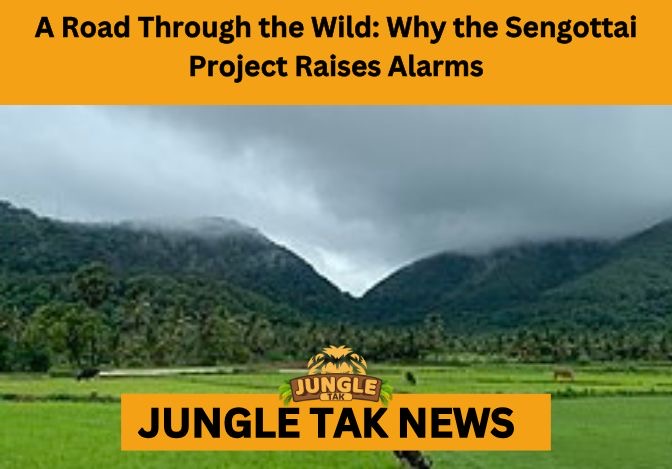
The primary objective of the Sengottai road project is to facilitate smoother transit between the states of Tamil Nadu and Kerala. By widening the existing lanes to accommodate heavy industrial traffic and increasing tourism, the government aims to boost the economy of Southern India. However, the geography of the region means that this expansion directly carves through some of the most sensitive forest patches in the Aryankavu valley and the surrounding hills.
One of the most significant concerns regarding the Sengottai road project is its proximity to the Srivilliputhur-Megamalai Tiger Reserve (SMTR). As a critical buffer zone and a corridor for apex predators, any increase in vehicular noise, light pollution, and physical barriers could disrupt the hunting and mating patterns of the local tiger population. Conservationists argue that the project’s current design does not sufficiently account for the biological needs of these endangered big cats.
Beyond tigers, the Sengottai road project poses a direct threat to the ancient migratory routes of the Asian Elephant. These “mega-herbivores” require vast stretches of contiguous forest to survive, and the widening of the highway creates a “death trap” for herds moving between the Periyar and Agasthyamalai landscapes. Increased road width often leads to higher vehicle speeds, which historically correlates with a rise in fatal elephant-vehicle collisions in this specific mountainous pass.
Furthermore, the geological impact of the Sengottai road project cannot be ignored, as the Western Ghats are prone to landslides. Massive excavations and the felling of thousands of heritage trees to make way for the highway could destabilize the soil. Recent monsoon seasons have already shown that the region is vulnerable, and critics suggest that the massive infrastructure work involved in this project could exacerbate the risk of catastrophic mudslides for nearby villages.
Local communities and environmental NGOs have not stayed silent regarding the Sengottai road project. Several petitions have been filed with the National Green Tribunal (NGT), calling for a more comprehensive Environmental Impact Assessment (EIA). The protesters argue that the current reports downplay the severity of the habitat loss and fail to offer a transparent plan for compensatory afforestation, which rarely replaces the complex biodiversity of an old-growth forest.
From an economic perspective, the government maintains that the Sengottai road project is vital for reducing travel time for farmers and traders moving goods from the ports of Kerala to the markets of Tamil Nadu. They emphasize that the current two-lane road is a bottleneck that stifles growth and causes frequent traffic congestion. However, many residents wonder if the short-term economic gains are worth the long-term loss of the natural heritage that sustains the local climate and water cycle.
To address these concerns, some experts have suggested that the Sengottai road project should incorporate elevated corridors or tunnels. While these alternatives are significantly more expensive than traditional road widening, they allow wildlife to pass underneath or above the traffic, maintaining habitat connectivity. Incorporating such “green infrastructure” could be the only way to satisfy both the Ministry of Road Transport and the Ministry of Environment.
The controversy surrounding the Sengottai road project highlights the global struggle of balancing human ambition with ecological limits. As climate change accelerates, the role of the Western Ghats as a carbon sink and a rain-maker for Southern India becomes more crucial than ever. Sacrificing these forests for a faster commute is a trade-off that many scientists believe we can no longer afford to make.
CONTINUE READING WITH JUNGLETAK – RESCUED TIGER MANGALA
Ultimately, the fate of the Sengottai road project will serve as a precedent for how India handles future infrastructure projects in protected areas. Will the government prioritize high-speed transit at any cost, or will they listen to the alarms raised by the scientific community? As the legal battles continue, the wild inhabitants of the Sengottai gap remain in a precarious position, waiting to see if their home will be divided by a ribbon of asphalt.