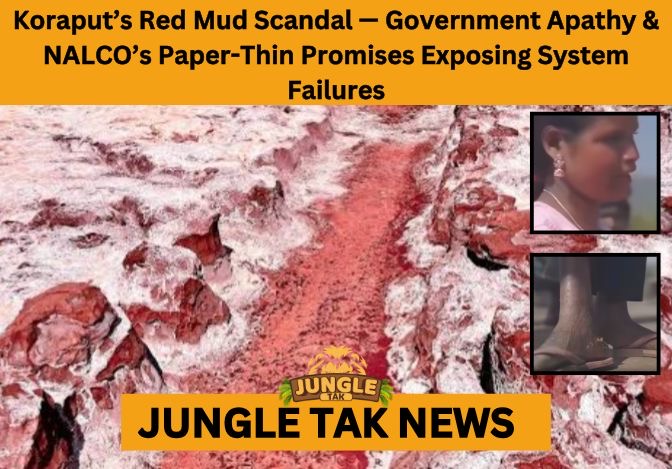

In the heart of Odisha’s tribal landscape, a slow-motion environmental catastrophe is unfolding, stripping the region of its natural beauty and health. The Koraput red mud scandal has emerged as a harrowing symbol of corporate negligence and institutional failure. As the hazardous byproduct of alumina refining leaks into the soil and water, the silence of the authorities is becoming deafening, leaving thousands of villagers to grapple with a toxic legacy that threatens their very existence and the sanctity of the Eastern Ghats.
The Genesis of a Toxic Crisis in Damanjodi
The residents of Damanjodi and surrounding villages have lived in the shadow of the massive bauxite mines for decades, initially welcoming the promise of industrial prosperity. However, the recent escalation of the Koraput red mud scandal has turned their fertile ancestral lands into a rust-colored wasteland. Red mud, a highly alkaline residue left over from the processing of bauxite into alumina, is reportedly spilling over from containment ponds. This caustic sludge is seeping into the groundwater and local streams like the Patal River, which the community relies on for drinking, bathing, and irrigation.
The physical manifestation of the Koraput red mud scandal is impossible to ignore. Huge swathes of land are now covered in a thick, red silt that hardens like concrete when dry, suffocating the roots of trees and preventing any new growth. For the local tribal populations, whose lives are intrinsically linked to the forest and the earth, this contamination represents an existential threat that goes far beyond simple property damage; it is the destruction of their heritage.
NALCO’s “Paper-Thin” Promises and Technical Failures
National Aluminium Company Limited (NALCO), a Navratna Public Sector Undertaking, has consistently maintained that its operations adhere to international safety and environmental standards. Yet, the evidence on the ground regarding the Koraput red mud scandal tells a different story—one of structural neglect and “paper-thin” promises. Despite numerous public assurances that the red mud ponds (tailing dams) would be reinforced with state-of-the-art liners and monitoring systems, the frequent reports of seepage suggest a total lack of technical accountability.
The failure to implement a sustainable waste management strategy is at the core of the Koraput red mud scandal. While NALCO claims to explore “value-added” uses for red mud, such as in brick making or cement production, the sheer volume of waste generated far outstrips these minor initiatives. The result is an ever-growing mountain of toxic sludge that the current infrastructure was never designed to hold indefinitely, leading to the breaches that now haunt the local geography.
Bureaucratic Inertia and Government Apathy
Adding insult to injury is the perceived indifference of the state and central regulatory bodies tasked with protecting the environment. The Koraput red mud scandal has been met with a wall of bureaucratic inertia, where environmental clearances are often treated as mere formalities rather than binding contracts. Local activists and environmentalists argue that the Odisha State Pollution Control Board has failed to take any meaningful punitive action against the PSU, effectively granting a “license to pollute” to one of the state’s biggest revenue earners.
The lack of oversight in the Koraput red mud scandal highlights a systemic failure where economic targets are prioritized over the safety of marginalized communities. When leaks are reported, the standard response is often a superficial inspection followed by a temporary patch-up job, rather than a comprehensive overhaul of the waste disposal system. This cycle of neglect has emboldened the violators and left the victims without a platform for grievance redressal.
The Human Cost: Health and Livelihoods in Jeopardy
For the tribal families of the region, the Koraput red mud scandal is not merely a headline or a data point in an environmental report; it is an daily health crisis. Medical practitioners in the area have noted an alarming rise in skin diseases, chronic respiratory issues, and gastrointestinal problems among those living near the disposal sites. The alkaline dust from the dried-up sections of the ponds becomes airborne during the summer months, making the air almost unbreathable and coating homes in a fine, toxic powder.
The economic impact is equally devastating, as the Koraput red mud scandal has led to the virtual death of local agriculture. Farmers who once cultivated a variety of crops are now left with barren, contaminated fields. The red sludge alters the pH level of the soil so drastically that nothing can grow, and the livestock that graze on the affected vegetation often fall ill or die. This has forced many into a cycle of poverty and forced migration, as their traditional means of livelihood vanish under a layer of industrial waste.
A Call for Accountability and Restoration
As the scale of the disaster becomes undeniable, demands for an independent judicial inquiry into the Koraput red mud scandal are growing louder. Civil society groups are calling for a comprehensive environmental audit conducted by third-party experts, free from the influence of the corporation or the state government. There is an urgent need for a long-term restoration plan that includes the decontamination of water bodies and fair compensation for the health and property losses suffered by the villagers.
CONTINUE READING WITH JUNGLETAK – SATKOSIA ECO-TOURISM EXPANSION
Ultimately, the Koraput red mud scandal serves as a grim reminder of the dark side of India’s industrial ambitions. It exposes the deep-seated flaws in a system that allows corporate giants to operate with impunity while the most vulnerable citizens pay the price. Unless there is a fundamental shift in how industrial waste is managed and how environmental laws are enforced, the “red mud” will continue to stain not just the soil of Koraput, but the conscience of the entire nation.