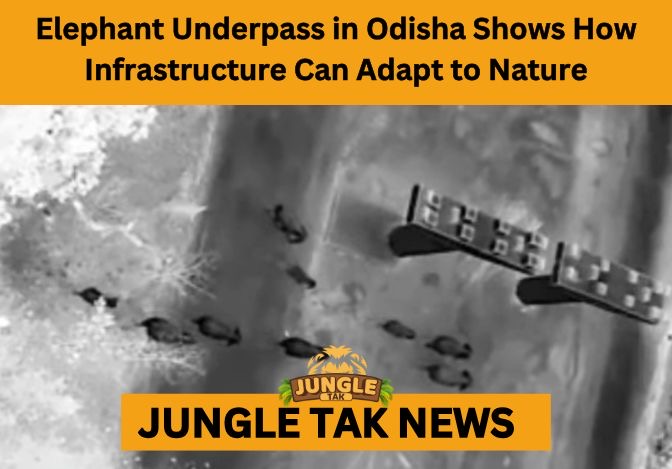

The rapid expansion of national highways and railway networks has often come at a steep price for India’s wildlife. However, a new chapter in conservation is being written in the eastern state of Odisha, where modern engineering is finally bowing to ancient migratory paths. The successful implementation of the elephant underpass in Odisha represents a landmark shift in how the country approaches infrastructure. By creating dedicated spaces for majestic tuskers to cross safely beneath busy roads, the state is proving that economic development and wildlife preservation do not have to be mutually exclusive.
For decades, the forests of Dhenkanal, Angul, and Sambalpur have been fragmented by high-traffic corridors, leading to a surge in tragic collisions between vehicles and pachyderms. The construction of the elephant underpass in Odisha was a direct response to these rising fatalities. These structures are specifically designed to mimic the natural environment, with heights and widths calculated to accommodate the size of a full-grown bull elephant and its herd. This ensures that the animals feel comfortable enough to use the passage rather than attempting a dangerous crossing over the asphalt.
A New Paradigm for Infrastructure Development
The concept of “Green Infrastructure” is no longer just a buzzword; it is a necessity for states with high biodiversity. The elephant underpass in Odisha serves as a prime example of how road projects can be modified to respect the “Right of Way” for animals. During the planning of the NH-55 expansion, environmentalists and engineers collaborated to identify traditional transit corridors. By integrating an elephant underpass in Odisha at these critical junctions, authorities have effectively reconnected fragmented habitats, allowing for the free movement of wildlife without disrupting the flow of human commerce.
One of the most significant hurdles in wildlife conservation is habituation. It takes time for wild animals to trust man-made structures, but recent camera trap footage has provided heartening evidence of success. Herds have been spotted moving through the elephant underpass in Odisha with minimal stress, often led by matriarchs who have recognized these routes as safe alternatives. This behavioral adaptation is a crucial win for the Forest Department, proving that the elephant underpass in Odisha is fulfilling its biological purpose.
Mitigating Human-Wildlife Conflict
Beyond the safety of the animals, these structures play a vital role in protecting human lives. When elephants are forced to cross highways, they often end up in close proximity to residential areas or agricultural fields, leading to dangerous encounters. By funneling the movement of these giants through an elephant underpass in Odisha, the state is reducing the frequency of crop-raiding and accidental human deaths. The stability brought by the elephant underpass in Odisha fosters a more peaceful coexistence between the local villagers and the local wildlife populations.
The economic benefits of these structures are also noteworthy. Frequent road accidents involving large animals cause significant damage to property and result in long traffic delays. By investing in the elephant underpass in Odisha, the National Highways Authority of India (NHAI) is essentially “future-proofing” its infrastructure against the costs of conflict. While the initial investment for an elephant underpass in Odisha may be higher than a standard road, the long-term savings in lives, insurance claims, and conservation efforts make it a highly cost-effective solution.
A Blueprint for Future Conservation
Odisha’s success is now serving as a model for other states across India and Southeast Asia. The data gathered from the monitoring of the elephant underpass in Odisha provides invaluable insights into animal psychology and transit patterns. Urban planners are now looking at the elephant underpass in Odisha to understand how to design similar “eco-bridges” for other species, such as tigers and leopards, ensuring that the country’s entire ecological web remains intact despite the pressures of urbanization.
Looking ahead, the state government has plans to increase the number of these structures in other sensitive zones. The commitment to building another elephant underpass in Odisha signifies a long-term vision where nature is treated as a stakeholder in every development project. As more data emerges, the design of the elephant underpass in Odisha will continue to be refined, perhaps incorporating better noise-cancellation features and more naturalistic landscaping to further encourage usage by the most elusive members of the herd.
CONTINUE READING WITH JUNGLETAK – TAMING OF ROGUE ELEPHANTS
In conclusion, the roar of highway traffic no longer has to signal a death knell for India’s elephants. The rise of the elephant underpass in Odisha is a testament to what can be achieved when empathy meets engineering. It stands as a beacon of hope, showing that with enough political will and scientific planning, we can build a world where the progress of humanity does not come at the cost of our natural heritage. The success of the elephant underpass in Odisha ensures that the giants of the forest can continue their ancient journeys in a modern world.