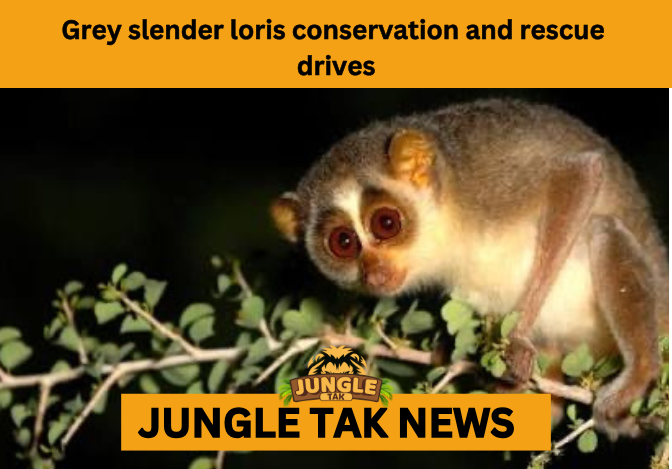

TAMIL NADU – Deep within the scrub forests of the Eastern Ghats, a pair of large, reflective eyes blinks against the harsh beam of a flashlight. This is the Grey Slender Loris, a shy, nocturnal primate that has quietly guarded India’s farmlands from pests for centuries. However, recent months have shattered this quiet existence. A surge in road accidents and the persistent shadow of illegal trade have triggered a massive, interstate mobilization of grey slender loris conservation and rescue drives, aiming to pull this enigmatic species back from the brink of local extinction.
The year 2025 has become a watershed moment for the species. While the establishment of the Kadavur Slender Loris Sanctuary—India’s first—was a historic victory, new data from surrounding regions indicates that the battle is far from over. From the bustling tech corridors of Bengaluru to the remote villages of Dindigul, the call to action is louder than ever.
2025 Census Alerts: The Spark for New Rescue Drives
The urgency behind the current wave of grey slender loris conservation and rescue drives stems from alarming new field data. A four-month study concluded in mid-2025 near the Alagarmalai foothills on the Madurai-Dindigul border revealed a startling trend: an estimated 80% decline in loris sightings compared to previous years. Researchers attribute this not to natural causes, but to the fracturing of their habitat.
“The grey slender loris conservation and rescue drives are no longer just about saving individual animals; they are about salvaging entire genetic populations,” says Dr. A. Kumar, a wildlife biologist involved in the study. “When tree canopies are severed by highways, these arboreal creatures are forced to crawl on the ground, where they are helpless against speeding vehicles.”
This data has galvanized the Tamil Nadu and Kerala Forest Departments to intensify their monitoring. In June 2025, the rescue of a baby loris in Kannur, Kerala, by the Malabar Awareness and Rescue Centre (MARC) made headlines, serving as a poignant reminder of the species’ vulnerability. The infant, found stranded and terrified, became the face of the renewed grey slender loris conservation and rescue drives in the region.
Combating the ‘Black Magic’ Trade
One of the darkest challenges facing grey slender loris conservation and rescue drives is the battle against superstition. For decades, these harmless primates have been poached for use in “black magic” rituals, with poachers believing the animals possess supernatural powers. Their body parts are often sold illegally, driving a silent but deadly underground market.
In response, recent months have seen a tactical shift. Anti-poaching watchers, often recruited from local tribes who know the forests best, are now leading grey slender loris conservation and rescue drives. In parts of the Dindigul district, former poachers have been rehabilitated and employed as “Loris Guardians.” Their deep knowledge of the animal’s roosting habits is now used to protect them rather than hunt them.
These intelligence-led grey slender loris conservation and rescue drives have resulted in the seizure of traps and the disruption of local supply chains. “We are seeing a change in mindset,” notes a forest range officer in Karur. “Villagers who once feared the loris as an omen are now alerting us when they see one in distress. That is the real success of our grey slender loris conservation and rescue drives.”
The Urban Challenge: Rescues in the Concrete Jungle
Surprisingly, the battleground for grey slender loris conservation and rescue drives extends into major cities like Bengaluru. Remnant patches of green in institutions like the Indian Institute of Science (IISc) still host fragile populations. However, urban expansion is lethal.
The “Urban Loris Project” and groups like People for Animals (PfA) have reported a steady stream of distress calls. In these concrete environments, grey slender loris conservation and rescue drives focus on mitigating electrocution threats and rescuing lorises stranded on power lines. The city-based rescue teams operate 24/7, acknowledging that for a nocturnal species, help often needs to arrive in the dead of night.
“Every rescue in the city is a miracle,” shares a volunteer from Bengaluru. “Our grey slender loris conservation and rescue drives in urban areas are a race against time. We are trying to preserve the last linkages of an ancient ecosystem that is being swallowed by concrete.”
Sanctuaries: The Anchor of Conservation
The success of the Kadavur Slender Loris Sanctuary has provided a blueprint for future grey slender loris conservation and rescue drives. Covering over 11,800 hectares, this protected area has allowed the forest department to implement strict speed limits on roads passing through the reserve, significantly reducing roadkill incidents.
Inspired by this success, activists in 2025 have renewed their plea to declare the Kesampatti region in Madurai a similar protected zone. They argue that grey slender loris conservation and rescue drives are most effective when backed by legal habitat protection. The proposed sanctuary would connect fragmented forest patches, allowing the lorises to migrate and breed without the fatal necessity of crossing human infrastructure.
Community Stewardship and Future Outlook
Ultimately, the sustainability of grey slender loris conservation and rescue drives depends on the people living alongside these primates. Educational programs in schools across Tamil Nadu and Kerala are now painting the loris not as a ghost, but as a farmer’s ally—a voracious eater of crop-destroying insects.
As we move towards 2026, the strategy is clear: combine high-tech monitoring and census data with grassroots community action. The grey slender loris conservation and rescue drives are evolving from reactive emergency responses into a proactive movement for coexistence.
CONTINUE READING WITH JUNGLETAK – PUDUCHERRY MANGROVE REVIVAL MISSION
A Fight for the Night’s Watchmen
The grey slender loris conservation and rescue drives underway in South India are a testament to the resilience of both nature and the human spirit. In saving this small, wide-eyed primate, we are protecting a vital link in our ecological web. The loris, often unseen and unheard, watches over our forests; it is now our turn to watch over them.