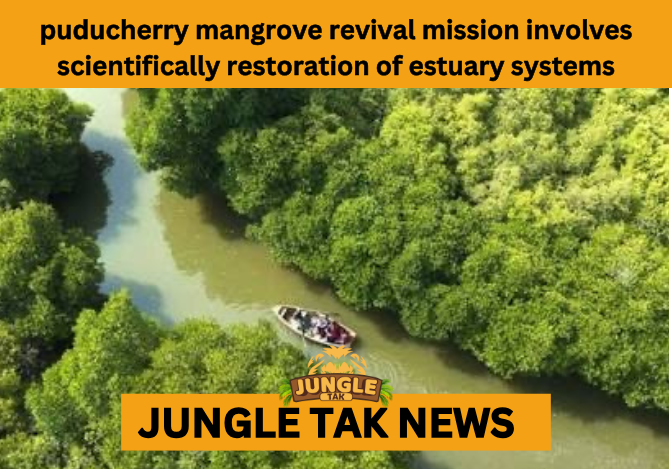

A New Dawn for Coastal Ecology
Puducherry: In a decisive move to safeguard its fragile coastline and bolster biodiversity, the Union Territory administration has launched the comprehensive PUDUCHERRY MANGROVE REVIVAL MISSION. This landmark environmental initiative was inaugurated this week amidst the scenic backwaters of Thengaithittu, signaling a major shift in the region’s approach to coastal management. As climate change accelerates the frequency of extreme weather events and rising sea levels threaten low-lying areas, this mission represents a proactive strategy to build a “bio-shield” around the coastal town. The project involves not just planting trees, but scientifically restoring the degraded estuary systems that serve as the lungs of the local environment.
The launch of the PUDUCHERRY MANGROVE REVIVAL MISSION comes at a critical juncture for the region. Environmentalists have long warned that the depletion of natural mangrove cover in the Ariyankuppam and Thengaithittu backwaters has left the coastline vulnerable to erosion and saline intrusion. By initiating this large-scale plantation drive, the government is acknowledging that concrete sea walls are not the only solution; nature-based solutions are equally, if not more, effective. The mission aims to reclaim hectares of barren mudflats and convert them into thriving green ecosystems over the next five years.
Restoring the Green Guardians
The core operational focus of the PUDUCHERRY MANGROVE REVIVAL MISSION is the systematic planting of indigenous mangrove species that are best water-resilient. Forest officials state that species such as Avicennia marina and Rhizophora mucronata have been selected for their robust root systems, which are capable of trapping sediments and stabilizing the shoreline. Unlike sporadic planting drives of the past, this mission is backed by a rigorous scientific framework that analyzes soil salinity, tidal amplitude, and water quality to ensure the highest survival rate for the saplings.
Furthermore, the PUDUCHERRY MANGROVE REVIVAL MISSION addresses the issue of habitat fragmentation. Over the decades, rapid urbanization and dredging activities have severed the connectivity between different mangrove patches. This mission intends to create contiguous corridors of green cover, allowing marine life and avian species to move freely. Authorities believe that once these corridors are re-established, the region will see a resurgence in biodiversity, particularly in the populations of migratory birds that flock to the Puducherry wetlands during the winter months.

Community and Corporate Synergy
The Power of Partnership
A unique aspect of the PUDUCHERRY MANGROVE REVIVAL MISSION is its collaborative model. The administration has made it clear that the Forest Department will not be working in a silo. Instead, the mission has roped in local NGOs, student volunteers, and private corporations under their Corporate Social Responsibility (CSR) mandates. By involving local fishing communities, the mission aims to instill a sense of ownership among the people who depend on these waters for their livelihood. Workshops are being conducted to educate locals on how mangroves act as nurseries for fish and crabs, directly linking the success of the mission to their economic well-being.
The financial sustainability of the PUDUCHERRY MANGROVE REVIVAL MISSION is being bolstered by these private partnerships. Several Puducherry-based industries have pledged funds and manpower to maintain the plantation sites for the first critical three years. This synergy ensures that the saplings are not just planted and forgotten—a common pitfall in mass afforestation drives—but are nurtured until they reach maturity. This “adopt-a-mangrove” approach is expected to be a game-changer for the long-term viability of the project.
Combating Climate Change and Carbon
On a macro level, the PUDUCHERRY MANGROVE REVIVAL MISSION is the Union Territory’s contribution to the global fight against climate change. Mangroves are known as “Blue Carbon” ecosystems because they sequester carbon dioxide at a rate up to four times higher than terrestrial rainforests. By expanding the mangrove footprint, Puducherry is effectively creating a significant carbon sink. Environmental experts point out that this mission aligns perfectly with India’s national commitments to increase green cover and reduce carbon emissions, placing Puducherry on the map as a model for small coastal administrations.
Moreover, the PUDUCHERRY MANGROVE REVIVAL MISSION acts as a critical defense mechanism against natural disasters. The memory of the 2004 Tsunami remains etched in the collective consciousness of the region, where areas protected by mangroves suffered significantly less damage than exposed shorelines. By fortifying the coast with this green wall, the administration is investing in disaster risk reduction. The dense root networks of the mangroves will serve as natural speed breakers for storm surges, protecting the inland settlements from the fury of future cyclones.
Boosting the Blue Economy
The economic implications of the PUDUCHERRY MANGROVE REVIVAL MISSION extend beyond disaster prevention; they promise a revitalization of the local blue economy. Fishermen in the area have reported declining catches in recent years, a trend often linked to the destruction of breeding grounds. Mangrove roots provide a safe haven for juvenile fish, shrimp, and crabs to grow away from large predators. By restoring these nurseries, the mission is expected to boost fish stocks in the estuary and the adjacent sea, eventually leading to higher incomes for the traditional fishing community.
Additionally, the PUDUCHERRY MANGROVE REVIVAL MISSION envisions the development of sustainable eco-tourism. The administration plans to introduce regulated kayaking and guided nature trails through the restored mangrove forests. This will not only generate revenue for the government and local guides but also serve as an educational tool for tourists. Visitors will be able to experience the tranquility of the mangrove tunnels firsthand, fostering a deeper appreciation for these swampy yet vital ecosystems.
Surveillance and Protection
To ensure the integrity of the project, the PUDUCHERRY MANGROVE REVIVAL MISSION includes strict protection protocols. The designated planting zones have been declared protected areas, with heavy penalties for dumping waste or encroaching on the mudflats. The administration is also deploying drone technology to monitor the growth of the saplings and detect any illegal activities within the mangrove zones. This high-tech surveillance underscores the seriousness with which the government is treating this ecological restoration.
Pollution control is another pillar of the PUDUCHERRY MANGROVE REVIVAL MISSION. The backwaters have long suffered from the inflow of untreated sewage and plastic waste, which can choke the breathing roots (pneumatophores) of the mangroves. As part of the mission, authorities are installing trash barriers at inlet points and ramping up sewage treatment capacities to ensure that the water feeding the new forests is clean and conducive to plant growth.
A Legacy for the Future
As the first batch of saplings takes root in the wet soil, the PUDUCHERRY MANGROVE REVIVAL MISSION stands as a beacon of hope. It is a testament to the fact that urban development and ecological preservation need not be at odds. The mission offers a blueprint for how coastal cities can reclaim their natural heritage while preparing for a climate-uncertain future.
CONTINUE READING WITH JUNGLETAK – OREGONS POPULATION
In the coming years, the success of the PUDUCHERRY MANGROVE REVIVAL MISSION will be measured not just in the number of trees surviving, but in the return of the otters, the nesting of the birds, and the security of the people living on the shore. It is a mission that demands patience and persistence, but for the coastal town of Puducherry, it is the most vital investment they can make for their children. The Green Wall is rising, and with it, a renewed promise of resilience.