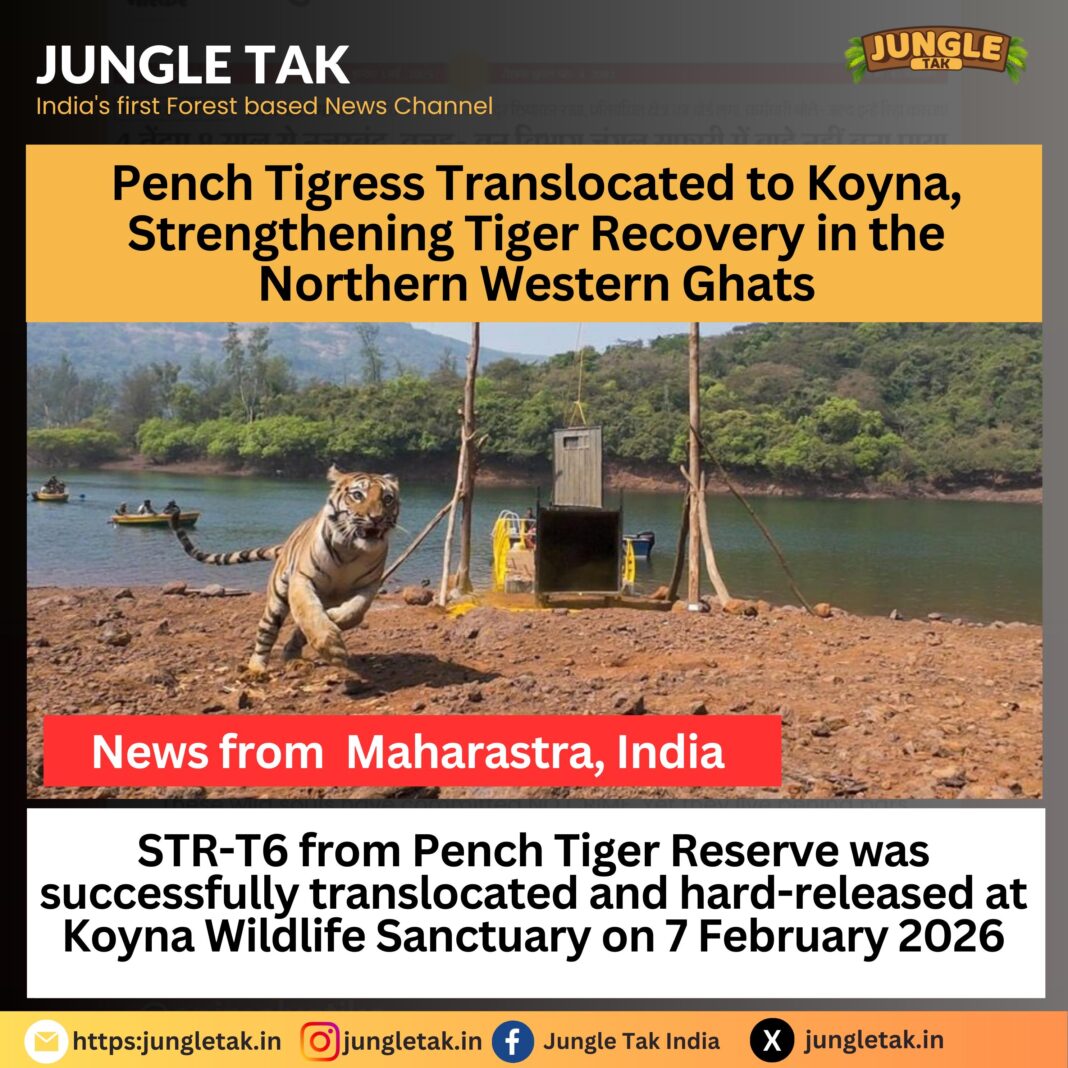

In a definitive move toward restoring the ecological balance of the Northern Western Ghats, the Maharashtra Forest Department achieved a significant milestone this week. On February 7, 2026, the long-awaited project reached its fruition as a young female Pench tigress translocated to Koyna was successfully released into her new habitat. This operation, part of a scientific reintroduction program, aims to revive the tiger population in the Sahyadri Tiger Reserve (STR), a landscape that has long awaited the presence of a breeding-age resident female to ensure its biological future.
The Identification and Selection of STR-T6
The tigress at the center of this conservation success story is officially identified as STR-T6. Originally hailing from the dense, prey-rich corridors of the Pench Tiger Reserve in Maharashtra, she was selected for her robust health, hunting prowess, and genetic suitability. The sight of this Pench tigress translocated to Koyna marks the culmination of months of rigorous vetting by the National Tiger Conservation Authority (NTCA). Biologists believe that STR-T6 possesses the perfect behavioral traits to adapt to the rugged, high-rainfall terrain of the Western Ghats, which differs significantly from the central Indian landscape.
A High-Stakes Journey for Conservation
The young and healthy female, approximately four years old, was carefully selected by experts from the Pench Tiger Reserve in Maharashtra based on her health profile and hunting capabilities. Before the Pench tigress translocated to Koyna began her cross-district journey, she underwent a series of rigorous medical examinations and was fitted with a sophisticated satellite radio collar. This technology is vital for the forest department to track her movements, monitor her health, and ensure she stays within the protected boundaries of the sanctuary.
The logistics of the operation were immense, involving a dedicated convoy of senior forest officials, experienced veterinarians, and specialized security personnel. Ensuring the safety and comfort of the Pench tigress translocated to Koyna during the hundreds of kilometers of transit was the top priority. The team utilized a specially designed climate-controlled vehicle and made periodic stops to monitor the animal’s vitals, ensuring that the stress of the journey did not compromise her well-being or her ability to adapt to her new home.
Why Koyna? Strengthening the Northern Western Ghats
Koyna Wildlife Sanctuary, a core component of the Sahyadri Tiger Reserve (STR), has been identified as a critical site for tiger recovery programs. While the habitat is rich in biodiversity, it has lacked a self-sustaining breeding population of tigers for several years. The arrival of the Pench tigress translocated to Koyna is expected to fill an apex predator niche that is essential for regulating the local herbivore population and maintaining the health of the entire forest ecosystem in the Western Ghats.
Scientific experts believe that the Northern Western Ghats are essential for the long-term survival of the Royal Bengal Tiger in Maharashtra. By having the Pench tigress translocated to Koyna, the state forest department is attempting to create a biological bridge between the tiger-rich landscapes of Central India and the southern reaches of the Western Ghats. This “genetic infusion” is necessary to prevent inbreeding and ensure that the future population of tigers in Sahyadri is resilient and healthy.
Rigorous Planning and Ecological Readiness
The National Tiger Conservation Authority (NTCA) granted the necessary approvals for this project only after conducting extensive feasibility studies regarding the prey base and habitat safety. These studies confirmed that the Pench tigress translocated to Koyna would find an abundant supply of sambar deer, barking deer, and wild boar. Furthermore, the forest department has spent months strengthening its protection net, increasing foot patrolling, and installing camera traps to ensure the landscape is safe from poachers before the release.
Upon her arrival at the sanctuary, the tigress was not immediately released into the deep woods; instead, she was placed in a large, secure “soft-release” enclosure. This acclimatization period is crucial for the Pench tigress translocated to Koyna, as it allows her to adjust to the local climate, scent, and terrain in a controlled environment. During this phase, she will be monitored 24/7 by a team of biologists who will observe her behavior and hunting patterns before she is granted full freedom in the wild.
Community Involvement and Future Outlook
The success of such a high-profile translocation also depends heavily on the support of the local communities living on the fringes of the forest. Forest officials have conducted multiple awareness programs to educate villagers about the importance of the Pench tigress translocated to Koyna and the benefits of a healthy tiger population for local eco-tourism. By involving the local population in conservation efforts, the department aims to minimize potential human-wildlife conflict and foster a sense of pride in the region’s natural heritage.
Looking ahead, the forest department plans to introduce a male tiger to the region to facilitate breeding and the establishment of a new lineage. The Pench tigress translocated to Koyna is essentially the “founder” of what scientists hope will be a thriving population of tigers that will one day roam freely across the Sahyadri range. Her successful adaptation will serve as a blueprint for future translocation projects across India, proving that with scientific precision and political will, lost species can be brought back to their ancestral homes.
CONTINUE READING WITH JUNGLETAK – MALE TIGER FOUND DEAD IN KAZIRANGA
As the Pench tigress translocated to Koyna begins her new life among the mist-covered peaks of the Western Ghats, the conservation world watches with bated breath. This project is more than just a single animal’s journey; it is a bold statement of India’s commitment to wildlife preservation. The hope is that her presence will revitalize the Sahyadri Tiger Reserve, ensuring that the Northern Western Ghats remain a vibrant, wild, and ecologically sound landscape for generations to come.