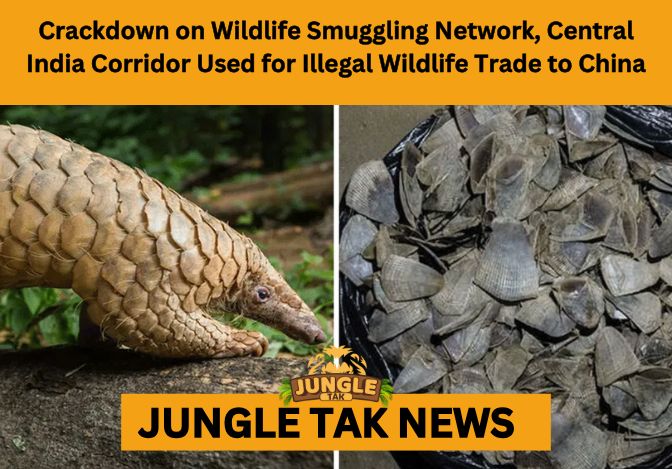

In a landmark victory for conservationists, a coordinated multi-agency operation has successfully infiltrated and dismantled a sophisticated illegal wildlife trade to China that had been operating deep within the heart of the Central India landscape. Over the past few weeks, a series of high-stakes raids across Madhya Pradesh, Chhattisgarh, and Maharashtra has exposed the dark underbelly of a transit corridor once reserved for tiger movement, now co-opted by international smuggling syndicates. This crackdown marks one of the most significant blows to organized environmental crime in the region in over a decade.
The Central Indian Corridor: A Highway for Contraband
The dense forests of the Kanha-Pench and Satpura-Melghat corridors have long been celebrated as the “highways” for India’s burgeoning tiger population, but intelligence reports now confirm they were also being used for the illegal wildlife trade to China. These corridors, which allow for the natural migration of apex predators, provided perfect cover for poachers and couriers to move animal parts across state lines without detection. By utilizing the remote, unmonitored trails of the Satpura Range, the syndicate managed to transport everything from tiger bones to pangolin scales, forming the first leg of a journey destined for the bustling black markets of East Asia.
Targeted Species: The High Value of Endangered Fauna
The primary focus of this specific illegal wildlife trade to China was the procurement of “high-value” biological contraband, including leopard skins, tiger skeletal remains, and the highly coveted scales of the Indian Pangolin. Investigators found that the demand for traditional medicine and luxury ornaments continues to drive a relentless pursuit of these species. Despite global bans, the perceived medicinal value of ground rhino horn and tiger bone glue remains a potent motivator for the middlemen who facilitate the movement of these goods through the porous borders of Northeast India and Myanmar.
Intelligence-Led Operations and the WCCB’s Role
This successful intervention was the result of months of “Operation Soft Gold,” an intelligence-led initiative spearheaded by the Wildlife Crime Control Bureau (WCCB) in collaboration with state Special Task Forces (STF). To stop the illegal wildlife trade to China, authorities utilized advanced cyber-forensics to track encrypted communications between local poachers and international handlers. By intercepting these digital breadcrumbs, the WCCB was able to identify the “consolidation points” where animal parts were stockpiled before being moved toward the transit hubs in West Bengal and Manipur.
The Myanmar-Manipur Transit Route Exposed
A critical revelation from the recent arrests is the reaffirmation of the “Eastern Route” as the primary artery for the illegal wildlife trade to China. Once the contraband leaves the Central India corridor, it is typically transported via rail or private vehicle to Moreh in Manipur or Champhai in Mizoram. From these border towns, the goods are smuggled into Myanmar and eventually reach the markets of Yunnan province. This complex logistical chain demonstrates that the smuggling network is not just a collection of local poachers, but a highly organized international enterprise with significant financial backing.
The Socio-Economic Drivers of Local Poaching
While the masterminds of the illegal wildlife trade to China reside in luxury, the actual killing is often carried out by marginalized communities living on the fringes of protected forests. During the interrogation of the suspects, it was revealed that many local conduits were lured by the promise of quick cash, often receiving only a fraction of the final market value of the animal. Addressing this vulnerability is now seen as a priority for the government, as systemic poverty in the forest fringes continues to provide a steady supply of “foot soldiers” for international criminal organizations.
Digital Footprints and the Dark Web Link
Modern technology has significantly altered the landscape of environmental crime, making the illegal wildlife trade to China harder to track than ever before. Smugglers are increasingly moving away from physical marketplaces and toward closed groups on social media platforms and the dark web to conduct their transactions. This digital shift allows buyers in Beijing or Shanghai to place orders in real-time for specific animal parts, which are then “harvested” to order in the jungles of Central India, creating a terrifyingly efficient “on-demand” system for extinction.
Impact on Biodiversity and the Ecosystem
The ecological consequences of the illegal wildlife trade to China extend far beyond the loss of individual animals. The removal of pangolins, often called the “scaly anteaters,” leads to an explosion in ant and termite populations that can destabilize local forest health. Similarly, the poaching of leopards and tigers—the umbrella species of the Central Indian landscape—disrupts the entire food chain, leading to an imbalance that affects water sources, vegetation, and the overall resilience of the jungle against climate change.
International Cooperation and Legislative Pressure
Stopping the illegal wildlife trade to China requires more than just domestic policing; it demands a robust diplomatic effort and international cooperation. India is a signatory to CITES (Convention on International Trade in Endangered Species of Wild Fauna and Flora), and officials are now calling for stricter enforcement of these treaties at the destination end. The Indian government is reportedly in talks with international law enforcement agencies, including INTERPOL, to ensure that the kingpins residing outside Indian borders are held accountable for the destruction of India’s natural heritage.
Strengthening the Future of Conservation
As the dust settles on this massive crackdown, the focus is shifting toward long-term prevention strategies to ensure that the illegal wildlife trade to China does not simply relocate to another corridor. This includes the deployment of more “e-Eye” surveillance systems—thermal cameras that monitor forest boundaries 24/7—and the recruitment of more local youth into the “Van Suraksha Samitis” (Forest Protection Committees). By turning former potential poachers into active protectors, the forest department aims to create a human shield that is impenetrable to the lures of the international black market.
CONTINUE READING WITH JUNGLETAK – BANDHAVGARH TIGER RESERVE
A Battle Far From Over
While the dismantling of this specific network is a monumental achievement, the war against the illegal wildlife trade to China is far from over. The high profit margins and the persistence of cultural myths regarding animal-based medicines mean that as long as there is demand, there will be attempts to supply. However, the message from the Central Indian corridor is now clear: the Indian state has the technological edge, the intelligence capabilities, and the political will to protect its wildlife from being sold to the highest bidder on the global stage.