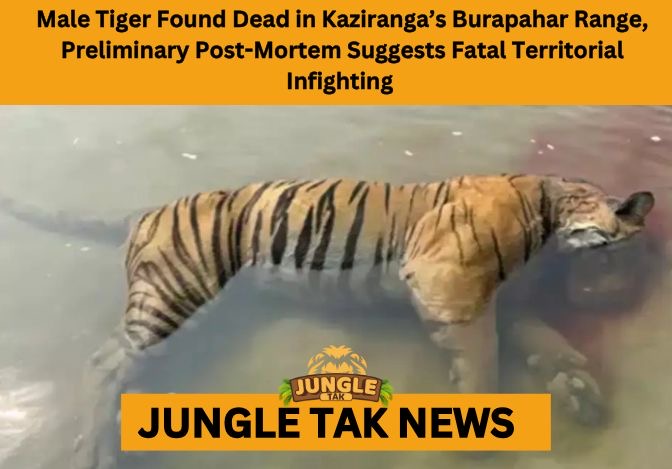

The serene landscape of Assam’s premier wildlife sanctuary has been clouded by a somber discovery this week. Forest officials confirmed that an adult male tiger found dead in Kaziranga National Park’s Burapahar range has sent ripples through the conservation community. While the loss of an apex predator is always a setback for biodiversity, initial investigations suggest that this was a natural, albeit violent, occurrence within the wild.
Discovery in the Burapahar Range
The carcass of the magnificent cat was spotted by patrolling guards during their routine morning rounds in the dense undergrowth of the Burapahar forest range. Upon locating the body, the staff immediately cordoned off the area to preserve potential evidence. The news of the tiger found dead in Kaziranga quickly reached senior park authorities, who dispatched a team of veterinarians and forensic experts to the site to determine the exact cause of the animal’s demise.
Preliminary observations at the scene indicated that the tiger had been dead for at least 24 to 48 hours before being discovered. There were visible signs of a struggle in the immediate vicinity, including flattened grass and broken branches. The physical state of the tiger found dead in Kaziranga suggested that it had engaged in a high-intensity physical confrontation, as evidenced by multiple external puncture wounds and lacerations.
Territorial Infighting: The Price of High Density
Kaziranga National Park is globally renowned for having one of the highest densities of Royal Bengal Tigers in the protected area network. While this is a testament to successful conservation efforts, it also leads to intense competition for space and resources. Experts believe the tiger found dead in Kaziranga was a victim of a territorial dispute, a common phenomenon when two dominant males cross paths in overlapping hunting grounds.
Territoriality is a biological necessity for male tigers, who require vast areas to ensure enough prey and access to mates. When a younger or stronger male attempts to usurp the territory of an established resident, the resulting battles are often fight-to-the-death encounters. In the case of the tiger found dead in Kaziranga, the severity of the neck and facial injuries pointed toward a classic predatory duel where neither side was willing to retreat.
Preliminary Post-Mortem Findings
A team of authorized veterinarians conducted the post-mortem examination following the strict protocols laid down by the National Tiger Conservation Authority (NTCA). The medical report confirmed that the tiger found dead in Kaziranga suffered from deep canine punctures to the vital areas of the neck and skull. These injuries are consistent with the bite force of another large male tiger, ruling out the likelihood of poaching or accidental poisoning at this stage.
Internal examinations further revealed significant hemorrhaging and muscle trauma. The medical team noted that the tiger found dead in Kaziranga was otherwise in healthy physical condition, with no signs of debilitating diseases or age-related weaknesses. This reinforces the theory that the death was a direct result of “internecine conflict,” a natural mechanism through which tiger populations regulate their social hierarchy and territorial boundaries.
Conservation Challenges and Population Dynamics
The incident highlights the double-edged sword of successful wildlife management in Assam. As the tiger population flourishes, the available land remains static, leading to increased friction between individuals. Every tiger found dead in Kaziranga due to natural causes like infighting is a reminder that the park may be reaching its carrying capacity, necessitating the protection of forest corridors that allow tigers to migrate to other habitats like Nameri or Orang National Parks.
Park Director and senior forest officials have reiterated that while the death is tragic, it is a part of the ecological cycle of the jungle. They emphasized that the tiger found dead in Kaziranga was not a victim of human interference, which provides some relief to the department. Surveillance in the Burapahar range has been intensified to monitor the “winner” of the fight, who is likely to have sustained injuries as well and may require monitoring.
Final Rites and Official Protocols
Following the completion of the autopsy and the collection of samples for toxicological analysis, the remains of the animal were disposed of according to legal requirements. The tiger found dead in Kaziranga was cremated in the presence of forest officials and independent observers to ensure that no body parts, such as claws or skin, entered the illegal wildlife trade. This transparency is crucial for maintaining the integrity of the park’s conservation record.
CONTINUE READING WITH JUNGLETAK – ODISHA ILLEGAL WILDLIFE TRADE
As the forest department awaits the final laboratory results, the focus remains on habitat management and the mitigation of human-wildlife conflict in the fringes of the park. The story of the tiger found dead in Kaziranga serves as a poignant chapter in the ongoing struggle for survival in the wild, showcasing the raw and unforgiving nature of the animal kingdom’s most iconic striped predator.