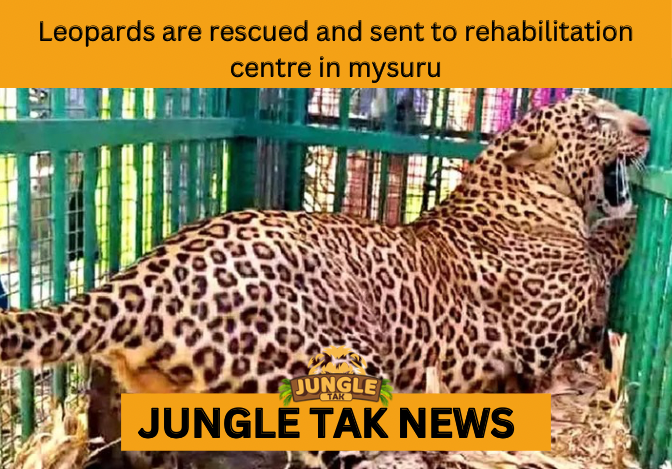

LEOPARD REHABILITATION CENTER MYSURU: Facing an unprecedented surge in human-animal conflict that has left farmers anxious and forest officials overwhelmed, the Karnataka Forest Department has formally proposed the establishment of a state-of-the-art LEOPARD REHABILITATION CENTER at the Aloka forest patch near Yelwala. The proposal, which is currently awaiting final budgetary approval from the state government, envisions a specialized facility designed to house, treat, and care for leopards that have been captured from conflict zones and cannot be released back into the wild.
The decision comes at a critical juncture for the Mysuru circle. Over the past two years, the region has transformed into a conflict hotspot. The expansive sugarcane fields of Mysuru, Mandya, and Chamarajanagar provide a perfect, albeit dangerous, artificial habitat for leopards. These “sugar-cane leopards” often stray into human settlements, leading to livestock predation and, tragically, fatal attacks on humans.
Currently, the captured felines are shifted to the Sri Chamarajendra Zoological Gardens (Mysuru Zoo) or the Bannerghatta Biological Park in Bengaluru. However, officials warn that these facilities are operating at or beyond their carrying capacity. The proposed LEOPARD REHABILITATION CENTER aims to decongest these existing zoos. The chosen site in Yelwala, specifically the forest land surrounding the historic Aloka Palace, is considered ideal due to its existing vegetation, proximity to the city for veterinary support, and relative isolation from dense urban sprawl.
The Urgent Need for Specialized Infrastructure
The logic driving this proposal is rooted in the biology of the “conflict animal.” Unlike tigers, leopards are highly adaptable and can live in close proximity to humans. When a leopard becomes a “man-eater” or a habitual livestock killer, it is captured in a cage trap. According to the National Tiger Conservation Authority (NTCA) and wildlife guidelines, such animals cannot be released back into the forest as they will almost certainly return to human habitations, posing a grave risk to public safety.
This creates a logistical bottleneck: What do you do with dozens of captured healthy leopards? A dedicated LEOPARD REHABILITATION CENTER is the only humane and scientific solution. The proposed facility in Yelwala is expected to have the capacity to house over 50 leopards. The plan includes the construction of large, naturalistic enclosures that allow the animals to exercise and exhibit natural behaviors, rather than languishing in small treatment cages.
Senior forest officials state that the facility will be equipped with a modern veterinary hospital, quarantine zones, and a sensory-proof boundary wall to ensure zero interaction between the captive animals and the local villagers. “It is not just about caging the animal; it is about providing a quality of life for a predator that is serving a life sentence for following its instincts,” noted a wildlife activist supporting the move on LEOPARD REHABILITATION CENTER.
Local Apprehensions vs. The Necessity of a LEOPARD REHABILITATION CENTER
While the scientific and administrative rationale for the center is sound, the proposal has been met with mixed reactions from the local community in Yelwala. Residents of the villages surrounding the Aloka forest have expressed fear that establishing a center housing dozens of leopards might attract more wild leopards to the area due to scent/pheromone attraction, or pose a risk of escape.
However, experts argue that these fears, while understandable, are scientifically unfounded. A properly constructed LEOPARD REHABILITATION CENTER utilizes double-fenced perimeters and high-security protocols similar to maximum-security prisons. Furthermore, officials argue that the presence of the center will actually increase the safety of the region. It will ensure the permanent presence of forest staff, patrol vehicles, and rapid response teams (RRT) in Yelwala, which can respond instantly if a wild leopard is sighted in the vicinity.
The Forest Department is planning a series of awareness drives to educate the local panchayats. They aim to explain that the facility will not be a tourist spot like a zoo, but a restricted conservation zone. This distinction is crucial to preventing human disturbance and ensuring the stress-free existence of the inmates.
The Financial and Ecological Scope
The project is estimated to cost several crores, funding which will cover the construction of night shelters, moats, and the deployment of a dedicated veterinary team. If approved, this will be one of the few facilities in South India dedicated exclusively to the Indian Leopard (Panthera pardus fusca).
Conservationists have long argued that the focus has been disproportionately on tigers, leaving the leopard crisis unmanaged. The LEOPARD REHABILITATION CENTER represents a policy shift, acknowledging that as urbanization eats into the buffer zones of the Western Ghats, the leopard is the animal most likely to come into conflict with development.
The Aloka premises, historically a hunting lodge for the Maharajas of Mysore, offers a unique topography. It has a mix of scrub jungle and open spaces, mimicking the natural habitat of the leopard. By utilizing this land, the government also protects the patch from potential encroachment or conversion into real estate, serving a dual purpose of land conservation and animal welfare on LEOPARD REHABILITATION CENTER.
CONTINUE READING WITH JUNGLETAK – WILDLIFE SMUGGLING
As the proposal moves to the final stages of government clearance, the stakes are high. For the farmers of the Old Mysore region, the swift removal of problem animals is a matter of livelihood and life. For the Forest Department, the ability to humanely house these animals is a legal and ethical obligation.
The establishment of the LEOPARD REHABILITATION CENTER at Yelwala could become a model for other states grappling with similar issues. It signifies a move away from ad-hoc crisis management toward a sustainable, long-term strategy for coexisting with India’s most adaptable big cat. The coming months will be crucial as the department navigates the funding approvals and local community outreach to turn this blueprint into reality.