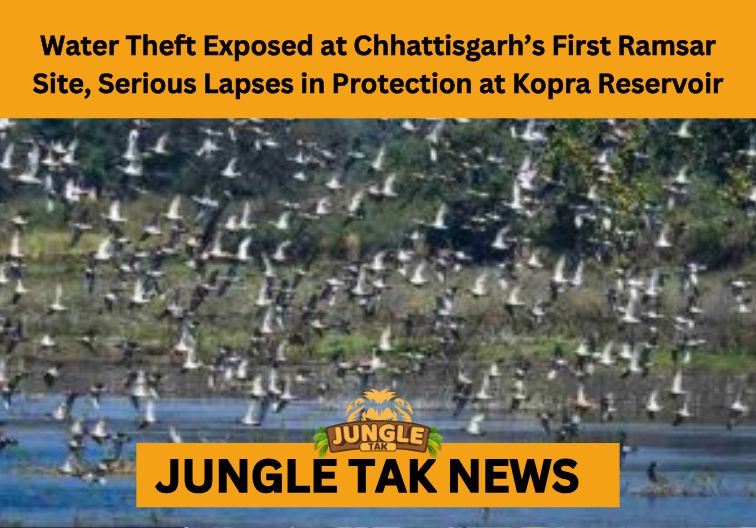

The declaration of the Kopra Reservoir in Bilaspur as Chhattisgarh’s first-ever Ramsar site was hailed as a landmark achievement for the state’s environmental conservation efforts. However, this celebration has been short-lived, as recent investigative reports have uncovered a massive scandal involving Kopra Reservoir water theft. The illegal extraction of water from this protected wetland has sparked outrage among environmentalists and locals, who claim that the very essence of the “Ramsar” status is being violated by administrative apathy and organized illegal activities.
The gravity of the Kopra Reservoir water theft cannot be overstated, especially considering that a Ramsar designation signifies a wetland of international importance. This status is granted to sites that play a vital role in maintaining global biological diversity and sustaining human life through the ecological services they provide. When water is stolen from such a delicate ecosystem, it disrupts the entire hydrological cycle of the region, leading to the gradual death of the wetland.
The Anatomy of the Crisis: How the Water is Being Stolen
Eyewitness accounts and local activists have pointed toward a sophisticated network behind the Kopra Reservoir water theft. Large-capacity motor pumps and hidden pipelines have reportedly been installed by powerful local entities and some agricultural landholders to divert water for commercial and private use. This unauthorized siphoning of water occurs mostly under the cover of darkness, suggesting a well-planned operation that bypasses the minimal security measures currently in place at the site.
Despite the reservoir being under the jurisdiction of state departments, the Kopra Reservoir water theft has continued unabated for months. The lack of a physical boundary or a dedicated patrolling team has made it remarkably easy for perpetrators to access the water body. This lapse in basic security infrastructure has turned a protected international site into an open resource for those looking to exploit natural assets for personal gain without any fear of legal repercussions.
Administrative Lapses and Governance Failure
The most shocking aspect of the Kopra Reservoir water theft is the apparent silence and inaction of the concerned authorities. Both the Forest Department and the Water Resources Department have been accused of passing the buck, with neither taking definitive responsibility for the protection of the reservoir’s water levels. This bureaucratic negligence has created a vacuum where illegal activities flourish, directly contradicting the conservation mandates required by the Ramsar Convention.
Environmentalists argue that the Kopra Reservoir water theft is a symptom of a larger systemic failure in Chhattisgarh’s environmental management. When a site is nominated for Ramsar status, the state government commits to a “wise use” policy, which includes strict monitoring and protection. However, the ground reality at Kopra suggests that the designation was pursued more for prestige than for genuine ecological preservation, as evidenced by the lack of even a basic management plan to prevent water diversion.
Ecological Impact: A Threat to Migratory Birds
The primary reason Kopra was recognized internationally was its role as a sanctuary for thousands of migratory birds. The ongoing Kopra Reservoir water theft is rapidly shrinking the water spread area, which is essential for species like the Northern Pintail, Bar-headed Goose, and various types of ducks that travel thousands of miles to winter here. As the water level recedes prematurely due to theft, these birds lose their foraging grounds and become vulnerable to predators and heat stress.
Beyond the avian population, the Kopra Reservoir water theft is destroying the local micro-ecosystem. The aquatic plants, fish species, and amphibians that form the food chain are dying off as the wetland turns into a dry patch of land long before the summer peak. If the water levels are not restored and protected, there is a high risk that the reservoir will lose the very biodiversity markers that qualified it for the Ramsar list in the first place.
The Legal and International Implications
The international community views the protection of Ramsar sites with high scrutiny, and the Kopra Reservoir water theft could put India in an embarrassing position on the global stage. Under the Ramsar Convention, the central and state governments are obligated to report any change in the ecological character of the site. Ignoring the illegal extraction of water could lead to the site being placed on the Montreux Record—a register of wetland sites where changes in ecological character have occurred or are likely to occur as a result of human interference.
Furthermore, the Kopra Reservoir water theft constitutes a direct violation of the Wetlands (Conservation and Management) Rules, 2017. These rules strictly prohibit any activity that involves the reclamation of wetlands or the diversion of water in a way that harms the ecosystem. Legal experts suggest that a high-level judicial inquiry is needed to identify the officials whose negligence allowed this theft to occur and to ensure that the culprits behind the illegal pumps are prosecuted under environmental protection laws.
A Call for Immediate Intervention
To stop the Kopra Reservoir water theft, the state government must act with urgency. The first step should be a complete audit of the water levels and the immediate removal of all illegal pumping sets and pipelines. There is also a desperate need for a dedicated “Wetland Task Force” composed of local community members and forest officials who can provide 24/7 surveillance of the reservoir’s perimeter.
Moreover, addressing the Kopra Reservoir water theft requires the installation of high-tech monitoring systems. Using satellite imagery and drone surveillance can help authorities track water level fluctuations in real-time and identify unauthorized human presence. Public awareness campaigns are also essential to ensure that the local population understands the international significance of the site and becomes a partner in its protection rather than a silent spectator to its destruction.
CONTINUE READING WITH JUNGLETAK – ILLEAGAL WILDLIFE TRADE
Saving Chhattisgarh’s Pride
The situation at Kopra Reservoir serves as a grim reminder that environmental titles mean nothing without ground-level enforcement. The Kopra Reservoir water theft is not just a local crime; it is an assault on a global heritage site. If Chhattisgarh wishes to remain a leader in biodiversity conservation, it must prove its commitment by ending the exploitation of its first Ramsar site and holding those responsible for these protection lapses accountable.
In the end, the resolution of the Kopra Reservoir water theft will determine the future of wetland conservation in the state. Protecting this reservoir is not just about saving water; it is about honoring an international treaty, preserving a vital stopover for migratory birds, and ensuring that future generations can witness the natural beauty of Chhattisgarh’s wetlands. The time for empty promises is over; the time for decisive action at Kopra Reservoir is now.