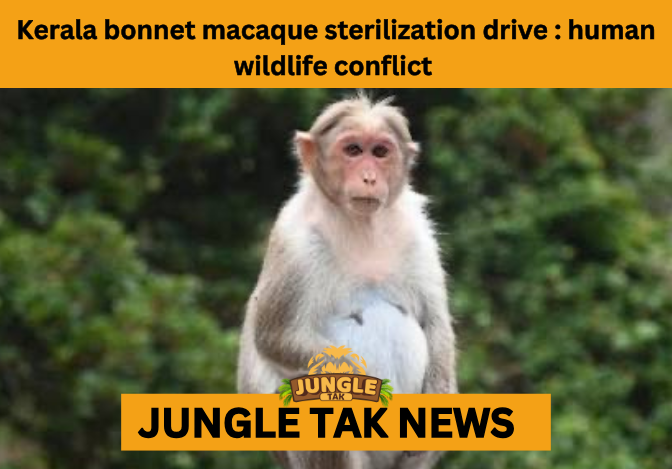

THIRUVANANTHAPURAM – In the verdant homesteads of Kerala, a battle for territory is being fought daily. On one side are the desperate farmers, watching their coconut and areca nut yields vanish into the canopy. On the other is the Bonnet Macaque, an endemic primate species fighting for survival in a fragmented landscape. caught in the crossfire is the Forest Department’s ambitious, yet fiercely debated, Kerala bonnet macaque sterilization program. As 2025 draws to a close, what began as a pragmatic solution to human-wildlife conflict has morphed into a complex controversy involving animal rights, ecological science, and agricultural survival.
The premise of the government initiative was straightforward: capture the “troublemaker” monkeys, subject them to laparoscopic sterilization, and release them back into the wild to curb population growth. However, recent reports from wildlife biologists and animal welfare groups have cast a long shadow over the efficacy and morality of the Kerala bonnet macaque sterilization program. Critics argue that the state is treating a symptom while ignoring the disease of habitat loss, potentially endangering a species that is not as overpopulated as it appears.
The Farmers’ Plea: A Crisis of Livelihood
To understand the support for the initiative, one must look at the agrarian distress. For the rubber and coconut planters in districts like Wayanad and Pathanamthitta, the monkey menace is not a nuisance; it is an economic disaster. Farmers’ collectives have long lobbied for the Kerala bonnet macaque sterilization program, arguing that culling is legally difficult and relocation is temporary. They point to the sheer visibility of the monkeys—troops raiding kitchens, destroying roof tiles, and decimating vegetable patches—as proof of an explosion in numbers.
For the agricultural community, the Kerala bonnet macaque sterilization program represents the only government intervention that promises a long-term reduction in conflict. “We cannot wait for forests to regrow,” says a representative of the Kerala Independent Farmers Association (KIFA). “We need the numbers down now. If the sterilization stops, we are left with no defense against an enemy that adapts faster than we can fence our lands.”
The Scientific Paradox: Abundance or Decline?
The controversy deepened significantly this year when a group of primatologists released data suggesting that the Bonnet Macaque (Macaca radiata) is actually facing a population decline in its natural forest habitats. This has led to a scientific standoff regarding the Kerala bonnet macaque sterilization program. Experts argue that the “overpopulation” seen in villages is actually “displacement.” As forest corridors are severed by highways and encroachment, monkey troops are forced into human settlements to scavenge.
By targeting these displaced populations, the Kerala bonnet macaque sterilization program might be inadvertently pushing a species that is already losing its genetic diversity toward local extinction. The International Union for Conservation of Nature (IUCN) has previously flagged the declining trend of this species. Biologists warn that sterilizing large numbers of healthy adults without a proper census of the deep-forest population is a gamble that ecological stability cannot afford to take.
Ethical Concerns and Animal Welfare
Beyond the numbers, the implementation of the drive has sparked outrage among animal rights activists. Allegations of poor post-operative care and trauma during capture have dogged the Kerala bonnet macaque sterilization program since its inception. Whistleblowers have shared footage of monkeys crammed into small cages for days, leading to high stress levels, aggression, and in some tragic cases, mortality due to infection or shock.
The standard operating procedure mandates that the animals be released at the exact spot of capture. However, tracking the success of this reintegration is difficult. Activists argue that the Kerala bonnet macaque sterilization program disrupts the delicate social hierarchy of macaque troops. When alpha males or high-ranking females are removed for surgery and returned with the scent of humans and medicines, they are often rejected by the troop, leading to the creation of “rogue” solitary monkeys that are more aggressive toward humans.
The Displacement Dilemma
A critical flaw highlighted by ecologists is that sterilization does not stop a monkey from eating. A sterilized monkey still needs food, and if the waste management in villages remains poor, the conflict continues. The Kerala bonnet macaque sterilization program prevents the birth of new monkeys, but it does nothing to deter the current generation from raiding crops. In fact, some studies suggest that the trauma of capture might make the animals more erratic.
Furthermore, the “vacuum effect” is a significant concern. If the Kerala bonnet macaque sterilization program successfully reduces the population in a specific village, the surplus food waste available there simply attracts a neighboring troop to move in. Without addressing the root causes—garbage disposal and habitat fragmentation—the sterilization drive becomes an expensive treadmill that the state runs on without moving forward.
Government Stance and Infrastructure
Despite the backlash, the Kerala Forest Department maintains that the Kerala bonnet macaque sterilization program is the most humane option available under the Wildlife Protection Act. The department has invested crores in setting up fully equipped Monkey Sterilization Centers (MSCs) in districts like Thrissur and Wayanad. Officials argue that halting the program now would render this infrastructure useless and betray the promise made to the farming community.
The Forest Minister recently stated that the government is open to refining the Kerala bonnet macaque sterilization program based on expert inputs. Proposals include better tagging of sterilized animals, improved veterinary oversight, and conducting a simultaneous state-wide census to understand the true population dynamics. The state insists that doing nothing is not an option when human livelihoods are being destroyed daily.
Legal Battles and the Road Ahead
The courts have now become the arbiter of this ecological dispute. Public Interest Litigations (PILs) filed this year have demanded a temporary stay on the Kerala bonnet macaque sterilization program, citing procedural violations and the lack of scientific backing. The judiciary has asked the state to produce data proving that sterilization has led to a tangible reduction in conflict, a metric that is currently hard to quantify.
As the legal proceedings continue, the future of the Kerala bonnet macaque sterilization program hangs in the balance. If the courts rule against it, the state will have to pivot toward habitat restoration and waste management—solutions that take years to show results. If allowed to continue, the program must evolve to address the ethical and scientific criticisms leveled against it to ensure it doesn’t do more harm than good.
CONTINUE READING WITH JUNGLETAK – OPERATION RED GOLD
Seeking a Middle Ground
The situation in Kerala serves as a grim case study for human-wildlife conflict management in the Anthropocene. The Kerala bonnet macaque sterilization program sits at the uncomfortable intersection of human need and animal rights. While the anger of the farmers is justified, the warnings of the scientists cannot be ignored.
Ultimately, a sustainable solution requires looking beyond the operating table. The success of any wildlife management strategy, including the Kerala bonnet macaque sterilization program, depends on restoring the ecological buffers that once separated the forest from the farm. Until the forests can once again sustain their children, the conflict on the fringe will likely continue, with or without the scalpel.