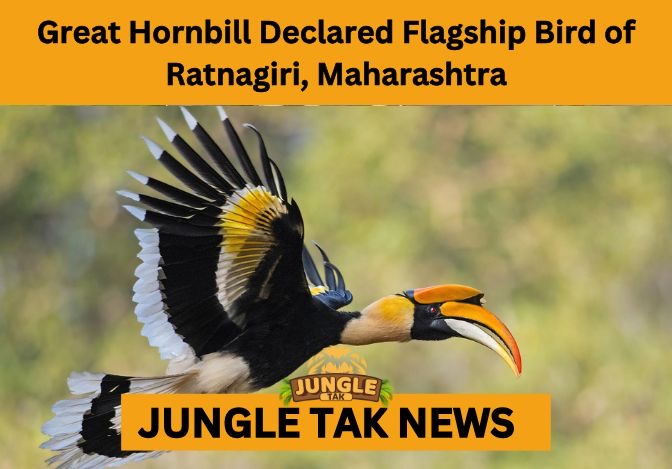

In a landmark decision aimed at bolstering avian conservation and highlighting regional biodiversity, the Maharashtra government has officially moved to have the Great Hornbill declared flagship bird of Ratnagiri. This significant administrative step underscores the ecological richness of the Konkan belt, which serves as a critical habitat for this prehistoric-looking species. By elevating the status of the Great Hornbill, authorities intend to create a powerful symbol for the district’s conservation efforts, ensuring that the protection of the Western Ghats remains a top priority for both the government and the local populace.
The announcement that the Great Hornbill declared flagship bird of Ratnagiri has been met with widespread enthusiasm from environmentalists and birdwatchers across India. Known for its massive wingspan, vibrant yellow casque, and deep, resonant call, the Great Hornbill is an essential component of the tropical evergreen forests found in Maharashtra. As a large-bodied fruit-eater, it plays a vital role in maintaining the health of these forests, making the decision to give it a specific regional title a move that is as scientifically sound as it is culturally significant.
The Ecological Significance of the Forest Farmer
One of the primary reasons behind the Great Hornbill declared flagship bird of Ratnagiri initiative is the bird’s unique role as a “forest farmer.” These birds consume large quantities of fruit and travel across vast distances, effectively dispersing seeds that contribute to the natural regeneration of the forest canopy. In the dense woods of the Ratnagiri district, many indigenous tree species rely almost exclusively on the Great Hornbill for propagation. By protecting this bird, the state is essentially ensuring the long-term survival of the entire forest ecosystem.
Furthermore, the Great Hornbill declared flagship bird of Ratnagiri designation allows the species to act as an “umbrella species” for the region. Conservation strategies designed to safeguard the nesting and foraging grounds of the hornbill—such as the preservation of old-growth trees—naturally extend protection to hundreds of other smaller bird species, reptiles, and mammals that share the same habitat. This holistic approach to wildlife management ensures that the resources allocated to this flagship species provide the maximum possible benefit to the surrounding biodiversity.
Boosting Eco-Tourism and the Local Economy
The news that the Great Hornbill declared flagship bird of Ratnagiri is also expected to provide a major boost to the burgeoning eco-tourism sector in the Konkan region. Ratnagiri is already a popular destination for its mangoes and beaches, but the formal recognition of its avian diversity adds a new dimension to its appeal. Bird photography and nature trails centered around hornbill sightings are likely to attract enthusiasts from around the world, creating sustainable economic opportunities for local communities that are invested in nature’s preservation.
By capitalizing on the Great Hornbill declared flagship bird of Ratnagiri status, local homestays and nature guides can offer specialized tours that focus on the district’s unique wildlife. This transition toward nature-based tourism provides an alternative to more destructive land-use practices, encouraging villagers to protect the forests and the nesting sites within them. When the community sees a direct economic benefit from the presence of these birds, they are more likely to participate actively in anti-poaching and habitat restoration programs.
Addressing Habitat Loss and Conservation Challenges
Despite its new status, the Great Hornbill declared flagship bird of Ratnagiri faces several environmental challenges that require urgent attention. Habitat fragmentation due to agricultural expansion and road construction remains a constant threat to the species’ survival. Great Hornbills are secondary cavity nesters, meaning they rely on natural hollows in large, mature trees to raise their young. The removal of such ancient trees in the district can lead to a significant decline in the breeding success of the local hornbill population.
The focus brought about by the Great Hornbill declared flagship bird of Ratnagiri move will likely lead to more stringent regulations regarding forest clearance and tree felling in identified sensitive zones. Additionally, it paves the way for dedicated research projects that can track the birds’ movements and health using modern technology like GPS tagging. Understanding how these birds navigate the changing landscape of Ratnagiri is crucial for developing infrastructure projects that are “wildlife-friendly” and do not disrupt established migratory or foraging corridors.
A Future of Sustainable Coexistence
Ultimately, the decision to have the Great Hornbill declared flagship bird of Ratnagiri represents a visionary shift in the state’s environmental policy. It fosters a sense of regional pride and encourages a culture of coexistence between humans and wildlife. As awareness programs begin to roll out across schools and local panchayats, the sight of a Great Hornbill soaring over the Konkan hills will be seen not just as a beautiful spectacle, but as a testament to the community’s commitment to its natural heritage.
CONTINUE READING WITH JUNGLETAK – CHILIKA LAKE FUNDING
In conclusion, having the Great Hornbill declared flagship bird of Ratnagiri is a celebration of the unique biological identity of the Konkan. As the state moves forward with its conservation agenda, this majestic bird will lead the way, serving as a reminder of the intricate connections that bind humans to the natural world. With the support of the government and the active participation of the public, the Great Hornbill will continue to thrive in the forests of Ratnagiri for generations to come.