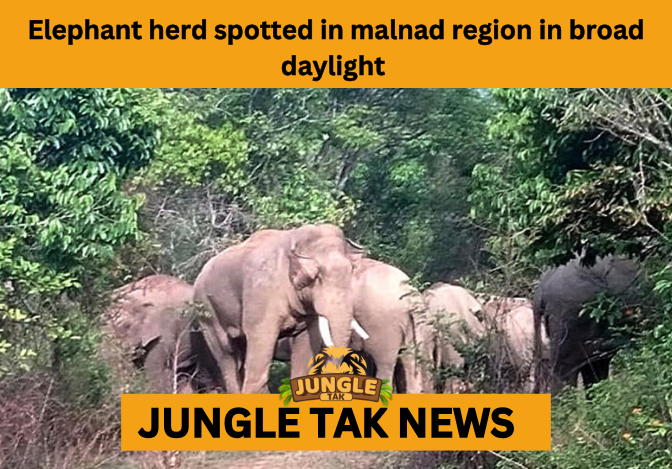

ELEPHANT HERD CHIKKAMAGALURU: The picturesque hills of the Muthodi range, usually serene with the aroma of ripening coffee, have been plunged into a state of high alert. On Wednesday, residents and motorists were left stunned and terrified when a massive ELEPHANT HERD comprising nearly 30 individuals, including vulnerable calves and protective matriarchs, emerged from the dense cover of the Muthodi forest region. The sheer size of the group, which is significantly larger than the typical family units usually sighted in these parts, has triggered widespread panic across the villages bordering the Bhadra Tiger Reserve.
The incident unfolded in broad daylight, turning a routine commute into a heart-stopping encounter for several motorists. Eyewitnesses reported that the ELEPHANT HERD lazily but deliberately crossed the main road connecting the interior villages to the district headquarters. Videos captured by trembling hands on mobile phones show the behemoths occupying the entire width of the tarmac, bringing vehicles to a screeching halt. In the footage, which has since gone viral on social media, the calves can be seen huddled in the center of the formation, flanked by aggressive adults—a defensive posture that wildlife experts warn makes the group unpredictable and highly dangerous.
The Anatomy of a Crisis: Why This Sighting is Different
While the Malnad region is no stranger to wildlife sightings, the scale of this incursion has alarmed both locals and conservationists. Typically, crop-raiding groups consist of solitary makhnas (tuskless males) or small family units of 4-5 animals. The presence of a ELEPHANT HERD numbering three dozen suggests a significant disturbance within the core forest areas or a major migratory shift. Residents of the Muthodi area, who live on the fringes of the wilderness, spent a sleepless night as the trumpet calls of the jumbos echoed through the valleys.
Local farmers, whose livelihoods depend entirely on the coffee and arecanut crops currently nearing harvest, are distraught. “We cannot send our laborers into the estates,” said Ramesh Gowda, a planter in the affected area. “When a single elephant enters, we can try to drive it away with drums and noise. But against a ELEPHANT HERD of this magnitude, we are helpless. They will trample acres of plantation in a single night if they decide to camp here.” The fear is palpable, with many schools in the vicinity declaring an unofficial holiday to ensure the safety of children who walk through these very paths.
Forest Department’s Response to the [ ELEPHANT HERD ] Movement
The Forest Department has swung into action, deploying rapid response teams (RRT) to the location. Senior officials confirmed that they are monitoring the movement of the animals closely. “The herd ventured out of the Muthodi forest region, likely in search of fodder or water,” stated a senior forest officer. “Our primary objective is to ensure they do not scatter into smaller groups, which would make them harder to manage. We are trying to drive the ELEPHANT HERD back into the reserve using non-lethal methods.”
However, officials also sought to quell the rising panic. “Wild elephant movement is common in this corridor, but we admit that this time, a very large number has left the forest together. We have advised villagers not to provoke the animals or attempt to take selfies, which is a major cause of accidents,” the officer added. The department has stationed jeeps with sirens and searchlights at strategic choke points to guide the animals away from the dense settlements of Chikkamagaluru taluk.
A History of Conflict: The Sringeri and Koppa Context
This incident is not an isolated event but the latest chapter in a bloody and costly struggle for space. The district has seen a sharp uptick in conflict over the last few years. In the neighboring Sringeri constituency, comprising NR Pura, Koppa, and Sringeri taluks, the situation has been dire. Just recently, the department had to conduct a complex operation to rescue and relocate five elephants that had been trapped in agricultural lands.
The recurrence of these incursions points to the failure of current mitigation strategies. As the ELEPHANT HERD moves through the landscape, it highlights the fragmentation of ancient corridors. With the expansion of agriculture and infrastructure, the animals find their traditional paths blocked, forcing them into direct confrontation with humans. The tragic toll of this conflict is measured in lives lost—both human and animal—and millions of rupees in crop damage.
The Demand for Rail Barricades
The sight of the massive group has reignited the long-standing demand for permanent solutions. The temporary solar fences and elephant-proof trenches (EPTs) have largely failed to contain the intelligent giants. Farmers are now vociferously demanding the installation of railway line barricades—fences made from old rail tracks that are considered the gold standard in elephant containment.
“We have been asking for rail barricades for five years,” said a representative of the local growers’ association. “The government announces funds, but the implementation is slow. Until a physical barrier stops the ELEPHANT HERD from leaving the Bhadra reserve, our lives will continue to be in danger.” The community is also calling for the establishment of a dedicated elephant camp in the region to house kumkis (trained elephants) that can be deployed immediately for driving operations, rather than waiting for them to be transported from Dubare or Sakrebailu camps, which takes precious time.
CONTINUE READING WITH JUNGLETAK – odisha elephants death
Conclusion
As night falls over Chikkamagaluru, the standoff continues. The forest department teams, armed with crackers and searchlights, are engaged in a tense game of patience with the giants. For the villagers, the majestic sight of the ELEPHANT HERD is overshadowed by the terror of what might happen if the animals turn towards their homes. The events of December 10-11 serve as a stark reminder that without a comprehensive, well-funded, and scientifically sound policy to manage wildlife corridors, the hills of the Western Ghats will remain a conflict zone.