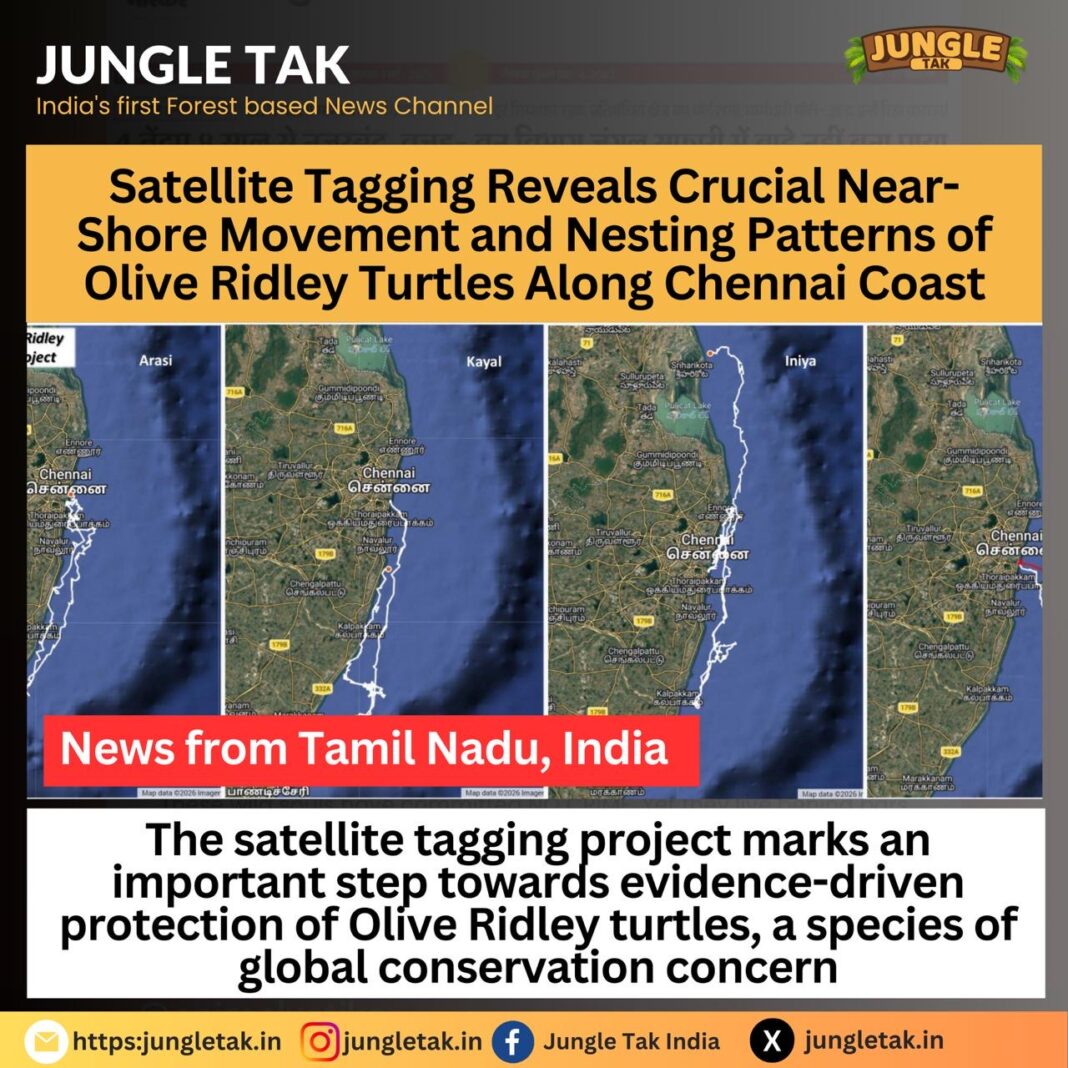

The sandy shores of Chennai have long been a sanctuary for marine life, but recent scientific advancements in Olive Ridley Satellite Tagging are now providing an unprecedented look into the private lives of these ancient mariners. For decades, conservationists relied on manual patrolling and nest counting to estimate populations, yet the behavior of the turtles once they returned to the sea remained a mystery. Today, the integration of satellite telemetry has bridged this knowledge gap, offering a high-resolution map of how these creatures navigate the Bay of Bengal and interact with the coastal ecosystem.
As the nesting season reaches its peak, the Tamil Nadu Forest Department, in collaboration with premier research institutes, has intensified its Olive Ridley Satellite Tagging program. By attaching platform transmitter terminals (PTTs) to the carapaces of nesting females, researchers have begun to receive real-time location data. This data is proving to be a game-changer for marine biology, as it allows scientists to track the precise coordinates of the turtles as they transition from the shoreline back into the deep ocean currents, revealing a level of coastal dependency that was previously underestimated.
Mapping the Crucial Near-Shore Movement
One of the most significant revelations of the current Olive Ridley Satellite Tagging initiative is the discovery of extensive “near-shore movement.” Contrary to the popular belief that these turtles immediately head for deep international waters after laying their eggs, the satellite tracks show that they linger within 5 to 10 kilometers of the Chennai coast. This localized movement suggests that the coastal waters of Tamil Nadu serve as a critical “internesting habitat,” where females rest and recover before returning to the beach for subsequent nesting attempts within the same season.
The data gathered through Olive Ridley Satellite Tagging highlights the vulnerability of the species during this internesting period. Because the turtles remain so close to the shore, they are at a heightened risk of coming into contact with mechanized fishing trawlers and gillnets. Understanding these specific near-shore corridors through Olive Ridley Satellite Tagging allows authorities to implement more effective seasonal fishing bans in specific zones, ensuring that the turtles can navigate their reproductive cycles without the constant threat of accidental bycatch.
Unveiling Nesting Patterns and Site Fidelity
The precision of Olive Ridley Satellite Tagging has also shed light on the concept of site fidelity—the tendency of a turtle to return to the same beach to nest. Observations have shown that while some turtles are loyal to specific stretches like Marina or Besant Nagar, others exhibit a more nomadic nesting pattern, moving further south toward Pondicherry. By utilizing Olive Ridley Satellite Tagging, researchers can now predict which beaches are likely to see the highest density of arrivals, allowing for better allocation of resources for hatchery management and predator protection.
Furthermore, Olive Ridley Satellite Tagging has revealed that the nesting period is much more dynamic than a single event. A single female may come ashore up to three times in a season, with the satellite data showing her waiting patiently in the nearby swells for the perfect environmental conditions. The environmental cues that trigger these movements, such as tide height and sea surface temperature, are now being correlated with the tracking data provided by Olive Ridley Satellite Tagging, offering a holistic view of the turtle’s decision-making process.
Conservation Strategy and Policy Implications
The implications of Olive Ridley Satellite Tagging extend far beyond academic curiosity; they are actively shaping the future of coastal policy in India. The Ministry of Environment, Forest and Climate Change is using the insights from Olive Ridley Satellite Tagging to identify “Ecologically Sensitive Zones” (ESZ) along the eastern seaboard. If the data continues to show that specific offshore areas are hotspots for turtle activity, it could lead to stricter regulations on coastal construction, sand mining, and industrial discharge in those sensitive marine blocks.
Moreover, the success of Olive Ridley Satellite Tagging in Chennai has sparked a regional dialogue on transboundary conservation. As some tagged turtles begin their long-distance migration toward the waters of Sri Lanka or the Andaman Sea, the importance of international cooperation becomes clear. Through Olive Ridley Satellite Tagging, scientists are proving that these turtles are “international citizens,” and their survival depends on a unified conservation strategy that protects their migratory highways across the entire Indian Ocean.
Technological Challenges and Future Research
While the results of Olive Ridley Satellite Tagging have been transformative, the process is not without its challenges. Saltwater is a harsh environment for electronics, and the transmitters must be robust enough to withstand deep dives and abrasive contact with the ocean floor. Despite these hurdles, the latest generation of tags used in Olive Ridley Satellite Tagging features improved battery life and solar-recharging capabilities, ensuring that the data stream remains consistent for several months, or even years, providing a long-term perspective on post-nesting migration.
Looking ahead, the next phase of Olive Ridley Satellite Tagging will likely involve tagging male turtles and juveniles to understand their unique movements, which remain largely unstudied. By expanding the demographic of the Olive Ridley Satellite Tagging project, the scientific community can develop a comprehensive “life-history” model for the species. This will be essential for predicting how the population will respond to the dual threats of rising sea levels and warming ocean temperatures, both of which could alter the traditional nesting grounds tracked by Olive Ridley Satellite Tagging.
CONTINUE READING WITH JUNGLETAK – NATIONAL BIRD UNDER ATTACK
A New Era for Marine Conservation
In conclusion, the ongoing effort in Olive Ridley Satellite Tagging along the Chennai coast is a testament to the power of technology in service of nature. It has transformed a silent, invisible journey into a vivid digital map that demands our attention and protection. The wealth of information generated by Olive Ridley Satellite Tagging serves as a reminder that the health of our oceans is inextricably linked to the survival of these charismatic reptiles.
As the state government and local communities continue to support Olive Ridley Satellite Tagging, there is a renewed sense of hope for the species. By turning data into action, Chennai is setting a benchmark for how urban centers can coexist with migratory wildlife. The legacy of Olive Ridley Satellite Tagging will not just be the maps produced today, but the thriving population of turtles that will continue to grace our shores for generations to come, guided by the wisdom we gained from the sky.