
CAPTURED TIGER : Operation Mavanallah
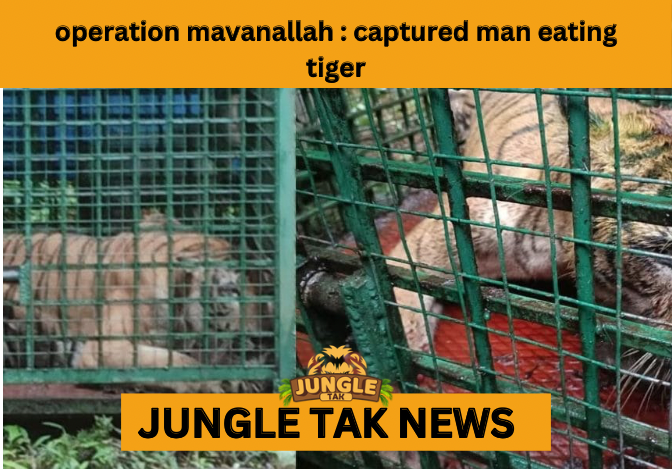
Udhagamandalam: A palpable sense of relief washed over the misty hills of the Nilgiris on Thursday morning as the Forest Department announced a major breakthrough in the conflict that had gripped the district. The CAPTURED TIGER, identified technically as MDT-37 (Mudumalai Tiger 37), was successfully trapped in a cage near the Mavanallah area of the Masinagudi division. For over two weeks, residents of the tribal settlements and tea estates had lived in the shadow of fear following a fatal attack, but the successful containment of the animal has finally restored a semblance of normalcy to the region.
The saga of the CAPTURED TIGER began on November 24, when tragedy struck the quiet hamlet of Mavanallah. B. Nagiammal, a 65-year-old tribal woman, was mauled to death while grazing her goats on a patch of patta land bordering the Mudumalai Tiger Reserve (MTR). The incident sent shockwaves through the community, sparking protests and terrified whispers about a “man-eater” on the prowl. The Forest Department immediately launched a massive hunt, deploying trackers, veterinarians, and armed guards to locate the predator before it could strike again.
According to Field Director of MTR, R. Kiruba Shankar, the operation to secure the CAPTURED TIGER was a meticulously planned exercise involving modern technology and traditional tracking skills. “We deployed 29 camera traps across the suspected range and used thermal-imaging drones to monitor the animal’s movement at night,” he explained. Unlike recent operations that required dangerous tranquilizer darting, this tiger was lured into a trap cage using bait, minimizing the physical stress on the already frail animal during the capture process.
The Science of Identification
Identification was a critical component of the mission. In the high-stakes environment of human-wildlife conflict, ensuring the right animal is targeted is paramount. Forest officials confirmed that the CAPTURED TIGER was indeed the same animal responsible for the attack on Nagiammal. “We compared the stripe patterns from the camera trap images taken immediately after the kill with the database of tigers in the reserve. The flank markings were a perfect match for MDT-37,” a senior biologist involved in the operation stated. This confirmation was vital to assuage the concerns of local villagers, some of whom briefly blocked the road demanding proof that the actual killer had been caught.
The physical examination of the CAPTURED TIGER revealed a grim reality that explains its deviation from natural prey to livestock and humans. The male tiger is estimated to be around 15 years old—a geriatric age for a wild tiger, whose average lifespan in the forest rarely exceeds 12 years. Veterinarians noted that its canines were severely worn out, and it bore old injuries on its face and limbs, likely scars from territorial fights with younger, stronger males. These physical handicaps rendered the CAPTURED TIGER incapable of hunting agile prey like spotted deer or sambar, forcing it to seek easier targets.
From Wilderness to Rehabilitation
Given the animal’s advanced age and deteriorating health, the Chief Wildlife Warden, Rakesh Kumar Dogra, made the critical decision not to release the CAPTURED TIGER back into the wild. Releasing an animal in this condition would be a death sentence for the tiger or a guarantee of further conflict for humans. Instead, the department issued orders to translocate the animal to the Arignar Anna Zoological Park in Vandalur, Chennai.This facility is equipped with a specialized rescue and rehabilitation center designed to care for wild animals that can no longer survive in their natural habitat.
The logistics of moving the CAPTURED TIGER are complex. A specialized ambulance vehicle, accompanied by a veterinary team, began the long journey from the cool heights of the Nilgiris to the humid coast of Chennai on Thursday. “The animal is being transported in the same cage it was trapped in to minimize handling stress. We have stocked sufficient water, beef, and mutton to keep it sustained during the travel,” said M.G. Ganesan, Deputy Director of MTR (Core Area).The team is expected to reach Vandalur by Friday morning, where the tiger will undergo a comprehensive health quarantine.
A Symptom of a Larger Crisis
The story of this CAPTURED TIGER is not an isolated incident but a symptom of the intense spatial pressure in the Nilgiri Biosphere Reserve. As tiger populations in Mudumalai and Bandipur stabilize and grow, older dominant males are often pushed out of prime forest areas by younger rivals. These displaced transients are forced into the “buffer zones”—the fringes where forest meets farm—leading to inevitable encounters with humans and livestock. MDT-37 was essentially a refugee in its own home, squeezed between the laws of nature and the boundaries of human expansion.
Conservationists argue that while the removal of the CAPTURED TIGER solves the immediate threat, the underlying issues remain. The corridors connecting the Western Ghats are increasingly constricted by resorts, fences, and roads. “When a tiger gets old, it needs a retirement plan. In the wild, that usually means death by starvation or fighting. But when human settlements are close by, they become the path of least resistance,” noted a wildlife expert based in Coimbatore. This incident highlights the need for better monitoring of aging tiger populations to preemptively manage potential conflict animals before lives are lost.
The Road Ahead
For the residents of Mavanallah, the departure of the CAPTURED TIGER brings a night of peaceful sleep after weeks of vigilance. Schools in the area, which had seen reduced attendance, and tea estate workers who had refused to enter the fields, are expected to return to their routines. However, the Forest Department has advised continued caution, maintaining a scaled-down patrol to ensure no other opportunistic predators move into the vacuum left by MDT-37.
CONTINUE READING WITH JUNGLETAK – OVERCROWDING CRISIS
As the CAPTURED TIGER settles into its new enclosure at Vandalur, it will serve as a living educational exhibit on the complexities of conservation. It will live out the rest of its days receiving medical care and guaranteed meals, far from the lush forests of Mudumalai where it once ruled. Its capture closes a bloody chapter in the Nilgiris, but the book on human-wildlife coexistence remains open, with difficult pages yet to be written. The survival of the species and the safety of the people depend on how effectively these lines are managed in the future.