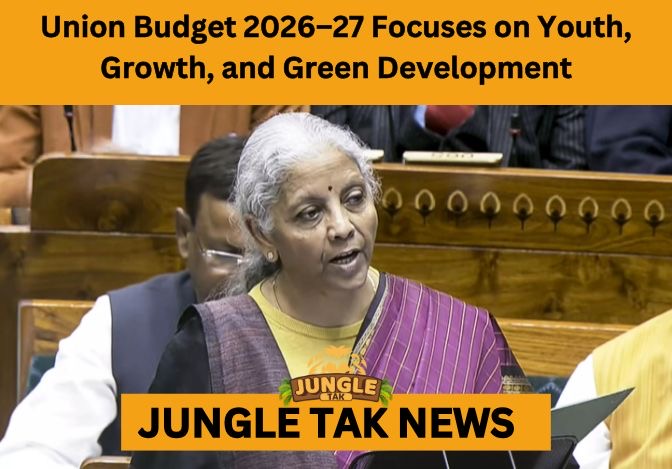

The announcement of the Union Budget for 2026-2027 has signaled a transformative era for the Indian economy, placing “Green Growth” at the absolute forefront of the national agenda. As the world grapples with climate volatility, the Indian government has used this fiscal policy to transition from traditional industrialism to a sustainable, low-carbon model. Central to this vision is the Budget 2026 Economic Roadmap, which outlines a rigorous path toward achieving net-zero emissions while simultaneously fostering job creation and high-speed economic expansion.
Powering the Future with Green Hydrogen and Renewable Energy
The primary pillar of this year’s environmental strategy is a massive capital injection into the National Green Hydrogen Mission. By providing significant production-linked incentives (PLI) for electrolyzer manufacturing, the government aims to position India as a leading global exporter of clean energy. The Budget 2026 Economic Roadmap allocates unprecedented funds to develop “Green Hydrogen Hubs” across coastal states, ensuring that the heavy industry sector—including steel and cement—can transition away from coal to a carbon-free fuel source.
Solar Expansion and the Decentralization of Power
In a move to empower both urban and rural households, the budget has expanded the “PM Surya Ghar” scheme, aiming to install rooftop solar systems in over 20 million homes. This initiative is designed to reduce the burden on the national grid while providing free electricity to millions of citizens. Under the Budget 2026 Economic Roadmap, the government is also subsidizing large-scale offshore wind projects and the development of high-capacity Battery Energy Storage Systems (BESS). These technologies are essential for managing the intermittent nature of renewable energy, ensuring a stable and 24/7 green power supply.
Accelerating the Electric Vehicle (EV) Ecosystem
The transport sector, a major contributor to carbon emissions, is undergoing a radical overhaul through new fiscal mandates. The budget introduces a streamlined “Green Mobility” tax structure that makes electric vehicles, particularly two-wheelers and public buses, more affordable than their internal combustion engine counterparts. The Budget 2026 Economic Roadmap includes a nationwide plan to install 100,000 fast-charging stations, powered primarily by renewable energy, thereby eliminating “range anxiety” and encouraging a faster transition to sustainable commuting.
Waste-to-Wealth: Pioneering the Circular Economy
Sustainability in the 2026-2027 budget extends beyond energy to the very way resources are consumed and reused. The “Galvanizing Organic Bio-Agro Resources Dhan” (GOBARdhan) scheme has been revitalized to convert cattle dung and municipal solid waste into compressed biogas (CBG). By integrating these waste-to-energy plants into the Budget 2026 Economic Roadmap, the government is tackling the dual challenges of urban waste management and rural energy poverty, creating a circular economy that generates both fuel and organic fertilizers for farmers.
Sustainable Agriculture and Forest Conservation
Recognizing that green development must include the restoration of natural carbon sinks, the budget has introduced the “Amrit Dharohar” and “Mishti” schemes for wetland and mangrove conservation. Farmers are being incentivized to shift from chemical-intensive agriculture to natural and regenerative farming practices. The Budget 2026 Economic Roadmap provides direct financial support for “Bio-Inputs Resource Centres,” which help farmers reduce their carbon footprint while increasing the nutritional value of their crops, ensuring that food security is achieved through eco-friendly means.
Green Jobs: Linking Youth Aspirations with Ecology
A unique feature of this year’s fiscal policy is the intentional overlap between youth employment and environmental stewardship. The government has launched a “Green Skills” training program aimed at preparing five million young professionals for roles in solar installation, EV maintenance, and carbon accounting. Within the Budget 2026 Economic Roadmap, these vocational programs are linked with “Green Startup” grants, encouraging young entrepreneurs to develop home-grown solutions for climate adaptation, thus ensuring that the transition to a green economy is a major driver of youth employment.
CONTINUE READING WITH JUNGLETAK – WILDLIFE CONSERVATION FACADE SHATTERED
A Sustainable Legacy for Future Generations
The Union Budget 2026-2027 is more than a financial statement; it is a manifesto for a cleaner, greener, and more resilient India. By weaving environmental consciousness into the fabric of infrastructure, agriculture, and manufacturing, the government has ensured that growth is no longer synonymous with pollution. The Budget 2026 Economic Roadmap provides the necessary framework to balance the needs of a burgeoning population with the urgent requirement for planetary health. As these policies take root, India is set to emerge not just as an economic powerhouse, but as a global leader in the sustainable development movement.