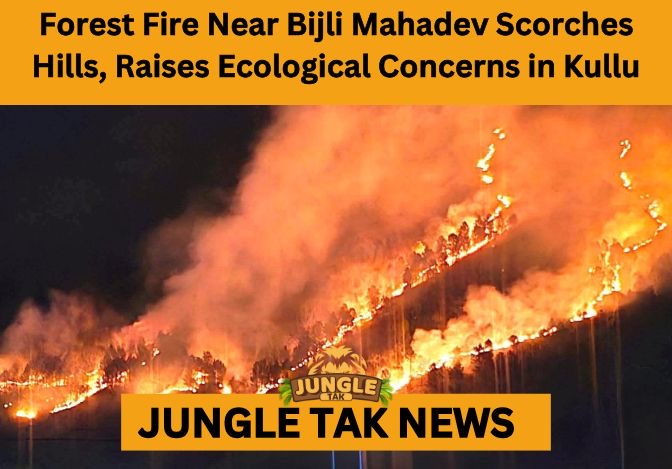

Kullu’s Bijli Mahadev forest fire
Massive plumes of thick, grey smoke are currently rising over the Kullu Valley as a devastating Bijli Mahadev forest fire sweeps through the pine-covered hills of Himachal Pradesh. The fire, which broke out in the late hours of the evening near the famous trekking trail, has quickly spread due to unseasonably dry conditions and high-altitude winds. This inferno now threatens the pristine beauty of one of the region’s most revered spiritual landmarks, casting a shadow over the “Valley of Gods.”
Emergency services were alerted when local residents noticed a persistent orange glow reflecting off the ridges, signaling the rapid escalation of the Bijli Mahadev forest fire. Despite the immediate mobilization of the Himachal Pradesh Forest Department and local fire brigades, the blaze has already consumed several hectares of sensitive forest land. Within a matter of hours, lush green slopes that serve as the lungs of the Kullu district have been transformed into charred, desolate remains.
The rugged and vertical topography of the Himalayan region has significantly hampered the efforts of ground teams to douse the Bijli Mahadev forest fire. Firefighters and forest guards are being forced to navigate steep, narrow trails with limited access to water, making the task of containing the perimeter an exhausting uphill battle. The lack of recent pre-monsoon rainfall in the area has further fueled the flames, turning the thick carpet of dry pine needles on the forest floor into a volatile tinderbox.
Environmentalists and conservationists are expressing deep concern over the long-term biological damage caused by the current Bijli Mahadev forest fire. This specific belt of the Himalayas is home to diverse avian species, including the Himalayan Monal, and various small mammals that have seen their nesting grounds destroyed overnight. The loss of old-growth cedar and Himalayan pine trees is a catastrophic blow to the local ecosystem, which may take several decades to fully recover from such an intense thermal event.
Beyond the immediate physical destruction of timber, the Bijli Mahadev forest fire has cast a thick shroud of toxic haze over the town of Kullu and surrounding mountain villages. This sudden and sharp drop in air quality is a major health concern for elderly residents and children, while also serving as a deterrent for the thousands of tourists who flock to the region for its crisp air. The fire’s proximity to the sacred temple trail has forced a temporary suspension of trekking activities, impacting the local tourism-dependent economy.
One of the most dangerous hidden consequences of the Bijli Mahadev forest fire is the impending risk of severe soil erosion and potential landslides. With the natural vegetation and root systems scorched away by the heat, the hillsides are now extremely vulnerable to the upcoming monsoon rains. Without the natural binding of the forest canopy and undergrowth, these scorched slopes could become unstable, posing a secondary threat of mudslides to the communities situated at the base of the hills.
Climate experts suggest that the increasing frequency and intensity of events like the Bijli Mahadev forest fire are direct symptoms of shifting climatic patterns across the Himalayan range. Rising average temperatures and prolonged dry spells are creating a permanent high-risk environment for wildfires in Northern India. This specific incident serves as a grim and timely reminder that traditional fire management strategies must be urgently updated to adapt to a rapidly warming mountain climate.
In a show of resilience, local volunteers and youth groups have joined forces with government officials to create manual fire lines, hoping to prevent the Bijli Mahadev forest fire from reaching nearby inhabited hamlets. This community-led effort highlights the deep spiritual and cultural connection the people of Kullu have with their natural surroundings. However, collective anxiety remains high among the villagers as the wind continues to shift, potentially pushing the flames into deeper, inaccessible valleys.
The district administration has officially launched an investigation into the primary cause of the Bijli Mahadev forest fire, looking for signs of human negligence or accidental ignition. Authorities are considering stricter penalties and the deployment of increased surveillance drones to deter such ecological disasters in the future. Protecting the sanctity of the Bijli Mahadev region requires a robust legal framework alongside modernized firefighting capabilities that can handle the unique challenges of high-altitude terrain.
CONTINUE READING WITH JUNGLETAK – CG STEPS UP TIGER ESTIMATION
As the sun sets behind a veil of smoke, the battle against the Bijli Mahadev forest fire continues into another grueling night for the frontline responders. The immediate priority remains the safety of human life and the preservation of what remains of the delicate Himalayan flora. It is now a critical race against time to extinguish the remaining hotspots and begin the arduous, multi-year process of ecological restoration in the heart of the Kullu Valley.