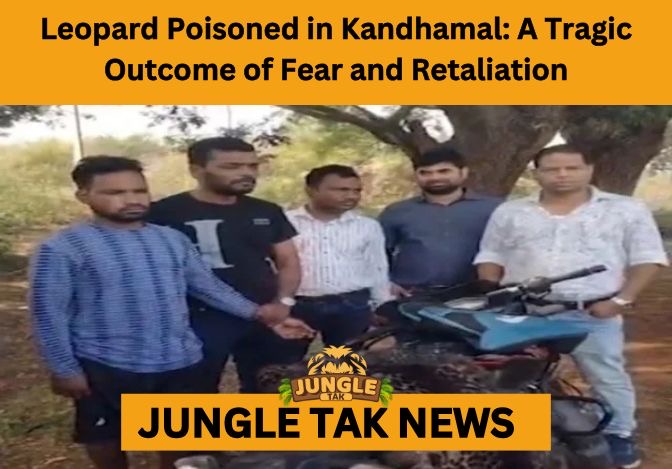

The serene forests of Odisha have recently been clouded by a dark cloud of conservation failure. The discovery of a leopard carcass in the Belghar range has sent shockwaves through the wildlife community, bringing the issue of leopard poisoning in Kandhamal to the forefront of national discussion. This incident is not merely a loss of biodiversity; it is a symptom of a deep-seated conflict between forest-dwelling communities and the majestic predators that share their landscape.
Preliminary investigations by the forest department suggest that the animal was targeted using a pesticide-laced carcass of a domestic animal. This specific instance of leopard poisoning in Kandhamal highlights a desperate and illegal method used by locals to safeguard their livelihood. When a leopard strays into human settlements and preys on livestock, the immediate reaction of the villagers, driven by fear and economic loss, often results in such fatal retaliatory measures.
The incident occurred near a remote village where livestock rearing is the primary source of income. For these villagers, the loss of a cow or a goat is a significant financial blow that the current compensation schemes often fail to address timely. Consequently, leopard poisoning in Kandhamal has become a tragic “short-term solution” for communities who feel they have been left to fend for themselves against apex predators without adequate protection or support from the state.
The Psychology of Fear and Retaliation
Fear plays a pivotal role in these tragic outcomes. When a large carnivore is spotted near a school or a residential area, the atmosphere becomes one of terror. This environment of panic often culminates in leopard poisoning in Kandhamal, as residents believe that killing the animal is the only way to ensure the safety of their children and property. Without proper awareness programs or rapid response teams, the gap between conservation goals and human safety continues to widen.
Ecologically, the loss of a leopard is a massive blow to the forest hierarchy. Leopards act as a check on the population of herbivores, and their absence can lead to an imbalance that affects the entire forest ecosystem. Every case of leopard poisoning in Kandhamal chips away at the genetic diversity of the species in the Eastern Ghats, pushing the local population closer to the brink of localized extinction.
Legal Consequences and Conservation Hurdles
Under the Wildlife Protection Act, the leopard is a Schedule I animal, granting it the highest level of legal protection. Despite these laws, the covert nature of leopard poisoning in Kandhamal makes it difficult for authorities to track and prosecute the offenders. While the Forest Department has intensified patrolling and launched a formal inquiry, the challenge remains in proving intent and identifying the specific individuals responsible for laying the poison.
The Odisha Forest Department has been working on various mitigation strategies, but the recent leopard poisoning in Kandhamal suggests that these measures are not reaching the most vulnerable fringes of the forest. Experts argue that until there is a seamless, digital, and transparent compensation process for livestock loss, villagers will continue to take the law into their own hands to protect their meager assets.
Towards a Sustainable Coexistence
To prevent another occurrence of leopard poisoning in Kandhamal, a multi-pronged approach is essential. This includes installing better lighting in villages, providing predator-proof sheds for livestock, and deploying dedicated “Leopard Task Forces” that can reach a conflict zone within minutes. Education is equally vital; villagers need to understand that the presence of a leopard is a sign of a healthy forest, which in turn provides the water and resources they depend on.
Furthermore, the government must prioritize community-led conservation. By involving the local youth in tracking and monitoring wildlife, the perception of the leopard can change from a “pest” to a “protector.” If the local population sees a financial or social benefit in the survival of the cat, the instances of leopard poisoning in Kandhamal will naturally decline as the community becomes the animal’s primary guardian.
CONTINUE READING WITH JUNGLETAK – ASIATIC BLACK BEAR CUB REHABILITATION
In conclusion, the tragedy in the Belghar range serves as a wake-up call for the state of Odisha. The heart-wrenching reality of leopard poisoning in Kandhamal is a reminder that conservation cannot happen in a vacuum. It requires the empathy, cooperation, and security of the people living on the front lines. Only by addressing the root causes of fear and retaliation can we ensure that the roar of the leopard continues to echo through the hills of Kandhamal for generations to come.