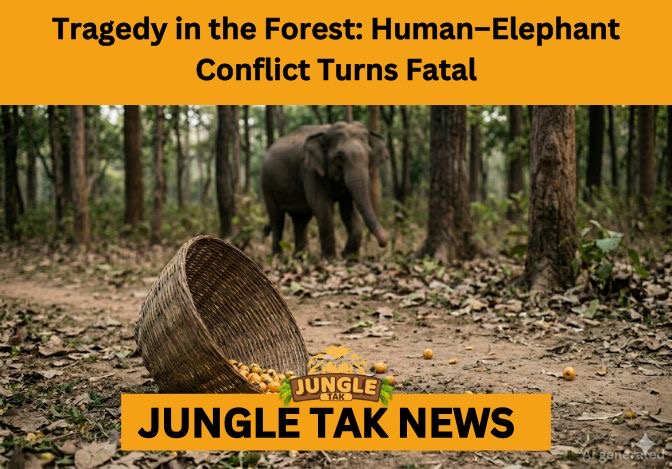

In a heartbreaking incident that has once again shaken the Gaurela-Pendra-Marvahi (GPM) district, a 55-year-old man was trampled to death by a wild elephant. The tragedy occurred in the early hours when the victim was reportedly caught off guard by a wandering tusker near his village. This horrific event serves as a grim reminder of the escalating Human-Elephant Conflict in Chhattisgarh, which continues to claim innocent lives in the state’s forest-fringe communities with alarming frequency.
A Life Lost in the Marvahi Forest Range
The victim, identified as a local resident of the GPM area, was reportedly out in the forest to collect forest produce when the fatal encounter took place. According to local sources, a lone tusker, separated from its herd, charged at the man before he could find safety. The speed and intensity of such attacks illustrate the sheer unpredictability and danger inherent in the Human-Elephant Conflict in Chhattisgarh, leaving rural families in a constant state of vulnerability.
Grief and Terror Grip Local Villages
Following the discovery of the body, a wave of grief and terror has gripped the surrounding villages, with many residents now too afraid to venture into the woods for their livelihoods. The forest, which has traditionally been a source of sustenance for the tribal populations, is now viewed with suspicion and fear. This immediate local fallout highlights the profound psychological toll and the disruption of daily life caused by the persistent Human-Elephant Conflict in Chhattisgarh.
GPM: A New Corridor for Wandering Herds
The Gaurela-Pendra-Marvahi district has increasingly become a critical transit point for elephants moving between the dense forests of Anuppur in Madhya Pradesh and the northern reaches of Chhattisgarh. As these majestic animals search for new corridors amidst a fragmented landscape, they inevitably cross paths with human settlements that were once considered safe. This geographical shift has inadvertently turned the GPM region into a primary hotspot for the Human-Elephant Conflict in Chhattisgarh.
Forest Department Response and Compensation
Forest Department officials reached the site promptly to conduct the panchnama and provide immediate relief to the bereaved family. While the state government provides ex-gratia compensation for such fatalities, the local community remains vocal about the fact that money cannot replace a loved one. The department currently faces the daunting task of patrolling massive forest ranges to mitigate the Human-Elephant Conflict in Chhattisgarh while managing a restless and expanding elephant population.
Habitat Destruction: The Root of the Crisis
Environmentalists point toward large-scale industrialization and the expansion of mining projects in neighboring districts as the primary reasons for habitat displacement. When elephants find their ancient migratory routes blocked by coal mines or heavy machinery, they are forced into agricultural lands and residential areas. As long as these corridors are disrupted, the root cause of the Human-Elephant Conflict in Chhattisgarh will remain unaddressed, leading to more inevitable tragedies.
Tracking Challenges in Rugged Terrain
Authorities have intensified their surveillance in the Pendra and Marvahi forest ranges, utilizing drones and tracking teams to monitor the movement of the rogue elephant. These technological interventions are intended to provide early warnings to villagers via mobile alerts and loudspeaker announcements. However, the rugged terrain and dense foliage often hamper the effectiveness of these tools in controlling the Human-Elephant Conflict in Chhattisgarh before an incident occurs.
The Role of Community Awareness
In response to the death of the 55-year-old man, the Forest Department has ramped up its community awareness programs to teach villagers the “Do’s and Don’ts” of elephant encounters. Residents are being advised to avoid forest areas after sunset and to refrain from stored mahua or liquor, which can attract elephants to their homes. Educating the public is a vital, albeit slow, strategy for de-escalating the Human-Elephant Conflict in Chhattisgarh and preventing further loss of life.
The Urgent Need for a Long-Term Solution
The tragedy in GPM underscores the urgent need for a permanent ecological solution, such as the full implementation of the Lemru Elephant Reserve. By providing a dedicated and protected habitat, the state can ensure that elephants have the resources they need without being forced to enter human territories. Without such landscape-level planning, the Human-Elephant Conflict in Chhattisgarh will likely continue to follow a cycle of violence and mourning.
CONTINUE READING WITH JUNGLETAK – BLACKBUCK REINTRODUCTION
A Call for Coexistence
As the people of Gaurela-Pendra-Marvahi mourn the loss of another life, the incident serves as a somber call to action for policymakers and conservationists alike. True progress in the state must include a strategy that protects both the tribal communities and the wildlife that shares their land. Solving the Human-Elephant Conflict in Chhattisgarh is not just a conservation goal; it is a humanitarian necessity to ensure that no more lives are lost in the shadow of the forest.