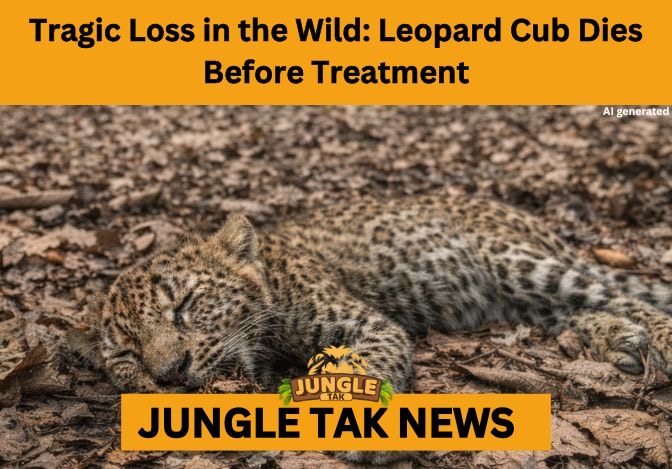

In a somber turn of events for wildlife enthusiasts and conservationists in Maharashtra, a young feline has passed away following a failed rescue attempt. The community is currently mourning as news broke from the Nashik district that a three-month-old leopard cub dies before treatment could be administered by the responding veterinary team. This tragic incident has once again brought the spotlight onto the precarious nature of wildlife survival in areas where human habitats and forest fringes overlap.
The incident unfolded early Tuesday morning when local farmers, heading to their sugarcane fields, spotted the small animal lying motionless near a drainage ditch. Despite the rapid response from the local Forest Department and animal rescue volunteers, the fragile leopard cub dies before treatment, highlighting the extreme physical vulnerability of young predators when they are separated from their mothers in the wild.
The Rescue Operation in Maharashtra
Upon arrival at the scene, rescuers found the cub in a severely dehydrated and lethargic state, showing signs of extreme shock. It was immediately clear that the animal had been separated from its mother for several days, and unfortunately, the leopard cub dies before treatment as its vital organs began to fail during the high-pressure transport to the nearest specialized rescue center. Such operations are often a race against time where every second determines the survival of the species.
Maharashtra, particularly regions like Nashik, Pune, and Junnar, has seen a significant uptick in human-wildlife encounters, often leaving young offspring caught in the crossfire of changing landscapes. In this specific case, the psychological and physical trauma of being alone proved too much for the animal, and the leopard cub dies before treatment, leaving experts to investigate whether the primary cause was a lack of nutrition or an underlying infection exacerbated by the cold.
Challenges in Wildlife Emergency Care
Veterinary experts who were waiting at the facility noted that the window for saving a wild animal in a state of shock is incredibly narrow. Even with the best medical equipment and life-saving drugs waiting at the Manikdoh Leopard Rescue Centre, the fact that the leopard cub dies before treatment underscores the inherent difficulties of stabilizing wild animals in the field. Unlike domestic pets, wild felines often mask their symptoms until they are at the point of collapse.
Local wildlife NGOs and activists have expressed their deep grief over the loss, emphasizing that every individual feline counts toward the state’s overall leopard population health. The tragedy where the leopard cub dies before treatment serves as a stark, painful reminder of the harsh realities faced by wildlife in the expanding urban-rural fringes of India. As habitats shrink, these young animals often find themselves in environments they are not equipped to navigate.
Investigating the Cause of Death
Forest officials in Maharashtra are now conducting a formal post-mortem to determine the exact physiological cause of the fatality. They are also actively searching for the mother leopard in the vicinity to ensure she is not injured or in distress, even though this leopard cub dies before treatment, marking a significant emotional and biological setback for the local conservation efforts this season.
This loss specifically highlights the urgent need for better-equipped mobile rescue units that can provide on-site stabilization and emergency fluids. When a leopard cub dies before treatment, it often points to the logistical challenges of navigating rugged rural terrain and heavy traffic to reach specialized animal hospitals located miles away. Experts suggest that “Golden Hour” treatment protocols, similar to human emergency medicine, are needed for wildlife.
The Way Forward for Conservation
As the news spreads through social media and local news outlets, citizens are calling for more awareness regarding what to do when they find a stranded or abandoned animal. The hope is that by educating the public to report sightings immediately and maintain a distance, we can prevent future scenarios where a leopard cub dies before treatment due to delayed reporting or unintentional human interference that scares off the mother.
CONTINUE READING WITH JUNGLETAK – RAJASTHAN TRAGEDY
Ultimately, the story of this young feline in Maharashtra is a loud call to action for stronger protection of wildlife corridors and more robust rescue infrastructure. While the leopard cub dies before treatment this time, the lessons learned from this tragedy must lead to better protocols and faster response times to save the next cub in need. Every life lost is a reminder that our coexistence with nature requires constant vigilance and improved resources.