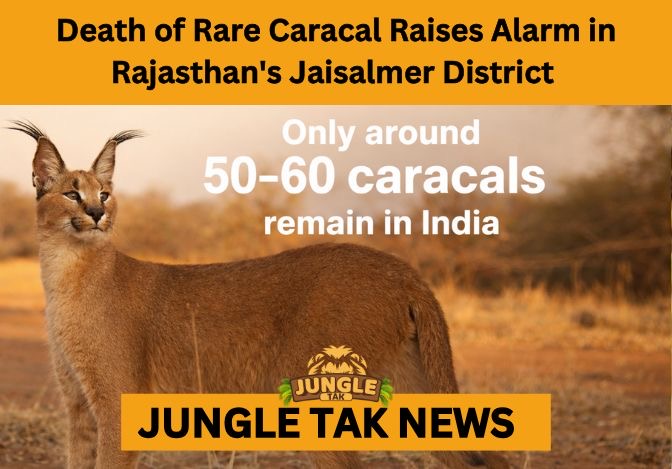
The wildlife conservation community in India has been plunged into a state of mourning following the discovery of the carcass of a rare caracal in the scrublands of Rajasthan. This tragic event has sent shockwaves through environmental circles, as this specific feline is currently teetering on the very edge of extinction within the Indian subcontinent. Forest officials and biologists are treating the incident with the utmost gravity, acknowledging that the loss of even a single rare caracal is a catastrophic blow to the recovery efforts of a species that is far more endangered than the Royal Bengal Tiger.
The Discovery in the Desert Corridor
Local forest rangers discovered the body of the rare caracal during a routine patrol in the rugged terrain that borders a protected sanctuary. Preliminary observations suggest that the animal had been dead for a couple of days, though the exact cause of death remains a subject of intense medical investigation. Whether the caracal succumbed to a territorial dispute with another predator or fell victim to a canine-borne disease, its passing marks a dark day for Rajasthan’s biodiversity. Experts are now conducting a thorough necropsy to rule out foul play or poisoning, which remain constant threats to the rare caracal in fragmented habitats.
A Population on the Brink of Extinction
To understand the gravity of this situation, one must look at the alarming statistics regarding the rare caracal population in India, which is estimated to be fewer than 50 individuals. Unlike other big cats that receive massive funding and media attention, the rare caracal—locally known as Siyagosh—has remained in the shadows, making its conservation journey an uphill battle. The death of this particular caracal in Rajasthan further thins an already shallow gene pool, making the species increasingly vulnerable to genetic bottlenecks and environmental changes.
Unique Biology of the “Leaping Hunter”
The rare caracal is renowned for its extraordinary physical attributes, most notably its long, black-tufted ears and its incredible ability to leap over ten feet into the air to catch birds mid-flight. Evolution has perfected the caracal for life in the arid and semi-arid regions of the Thar Desert and the ravines of Dholpur and Ranthambore. However, these specialized adaptations are not enough to protect the caracal from the rapid industrialization and agricultural expansion currently reshaping the Rajasthan landscape.
Escalating Threats from Human Encroachment
One of the primary reasons for the decline of the rare caracal is the relentless fragmentation of its natural habitat due to road construction and solar farm projects. As highways bisect ancient hunting grounds, the caracal is often forced to cross dangerous corridors, leading to frequent and fatal vehicular collisions. Furthermore, the encroachment of livestock into scrub forests brings the rare caracal into direct conflict with feral dog populations, which can transmit deadly viruses like canine distemper to the wild cats.
The Need for a Dedicated Conservation Plan
Following the death of this rare caracal, there has been a renewed and vocal demand for the Indian government to launch a specialized “Project Caracal” modeled after the success of tiger conservation. Currently, the rare caracal is listed under Schedule I of the Wildlife Protection Act, but critics argue that legal protection on paper is not enough to save the species from vanishing. Without a dedicated breeding program and the restoration of vast scrubland corridors, the caracal may soon become nothing more than a memory in the folklore of Rajasthan.
Technological Gaps in Tracking
The difficulty in studying the rare caracal stems from its secretive, nocturnal nature, which makes camera trapping and GPS tagging a logistical challenge for researchers. Because so little is known about the daily movements of the rare caracal, forest departments often struggle to implement effective “no-go zones” for development projects. This recent tragedy highlights the urgent need for more funding to be directed toward radio-collaring the remaining rare caracal individuals to better understand their habitat requirements and migration patterns.
A Final Warning for the Ecosystem
The death of the rare caracal in Rajasthan serves as a “canary in the coal mine” for the health of India’s desert and scrubland ecosystems. If we cannot protect a predator as resilient as the rare caracal, it signals a deeper collapse of the food chain that supports numerous other species. We must treat the preservation of the rare caracal as a national priority, ensuring that the silence of the Rajasthan scrublands is not made permanent by the extinction of its most beautiful inhabitant.
CONTINUE READING WITH JUNGLETAK – IIT-BOMBAY CROCODILE RESCUED
Looking Toward a Sustainable Future
As the investigation into this latest death continues, the hope remains that the public outcry will trigger a shift in how we value “lesser-known” species like the rare caracal. Conservation is not just about saving the famous megafauna; it is about protecting the intricate balance of nature that the rare caracal represents. Only through collective action and stringent habitat protection can we ensure that the rare caracal survives to leap across the Indian horizon once again.