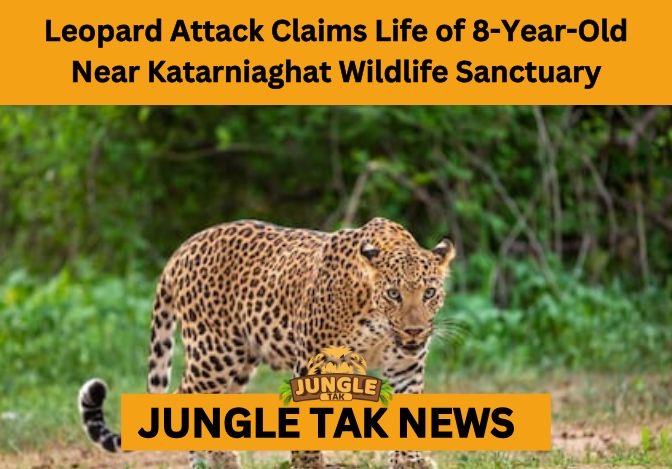

The fragile boundary between human settlements and wild habitats has once again been stained with tragedy. In a heart-wrenching incident that has sent shockwaves through the Bahraich district, an eight-year-old boy lost his life following a brutal leopard attack near Katarniaghat. This incident has reignited the intense debate regarding the safety of villagers living on the periphery of the Katarniaghat Wildlife Sanctuary, where predatory encounters are becoming alarmingly frequent.
Details of the Fatal Incident
The horrific leopard attack near Katarniaghat occurred late Tuesday evening in a village bordering the dense forest range. According to local sources, the young victim was playing near the courtyard of his house when the leopard, which had been lurking in the nearby sugarcane fields, pounced with lethal precision. The speed of the leopard attack near Katarniaghat left the family with almost no time to intervene, as the predator dragged the child toward the forest cover before the villagers could gather their wits and raise an alarm.
Upon hearing the screams, the villagers mobilized quickly, armed with sticks and torches, chasing the animal into the dark undergrowth. While their intervention eventually forced the feline to drop the child and retreat into the sanctuary, the damage from the leopard attack near Katarniaghat was already done. The boy had sustained deep wounds to his neck and chest; despite being rushed to the nearest medical facility, he was declared dead on arrival, marking another grim chapter in the history of a leopard attack near Katarniaghat.
Panic and Outrage Among Local Residents
Following the news of the child’s death, a sense of deep-seated fear and anger has gripped the local community. Residents claim that this specific leopard attack near Katarniaghat is not an isolated event but rather the culmination of several weeks of sightings that were reportedly ignored by the authorities. The trauma of the leopard attack near Katarniaghat has forced parents to keep their children indoors, and farmers are now terrified to enter their fields to harvest crops, fearing that a predator might be hiding in the tall stalks.
The psychological impact of a leopard attack near Katarniaghat extends beyond the immediate victim’s family. Entire villages are now living under a self-imposed curfew, with movement restricted after sunset. The community is demanding more than just verbal assurances; they are calling for permanent solutions to prevent any future leopard attack near Katarniaghat, such as the installation of high-intensity solar lights and the construction of reinforced fencing along the sanctuary’s borders.
Forest Department Response and Mitigation Efforts
In response to the fatal leopard attack near Katarniaghat, the Uttar Pradesh Forest Department has swung into high gear. Senior officials visited the site to offer their condolences and have deployed specialized teams to track the “man-eater” responsible for the leopard attack near Katarniaghat. To ensure the immediate safety of the villagers, two large cages have been strategically placed in the area where the predator was last seen, baited in hopes of capturing the animal involved in the leopard attack near Katarniaghat.
Furthermore, thermal drones are being utilized to monitor the movement of felines near human habitations to prevent another leopard attack near Katarniaghat. Forest rangers have also started conducting night patrols and are using public address systems to warn villagers against venturing out alone. While these measures are temporary, the department is under immense pressure to prove they can effectively manage the risks of a leopard attack near Katarniaghat and restore a sense of security to the region.
The Root Causes of Escalating Conflict
Wildlife experts point out that the recent leopard attack near Katarniaghat is a symptom of a much larger ecological issue. As human settlements expand and sugarcane cultivation reaches the very edge of the forest, the natural corridors for wildlife are being disrupted, leading to an inevitable leopard attack near Katarniaghat. Sugarcane fields, in particular, provide an ideal hiding spot for leopards, as the tall crops mimic their natural habitat and provide easy access to domestic livestock and, tragically, small children, increasing the likelihood of a leopard attack near Katarniaghat.
Conservationists argue that unless there is a clear demarcation and a functional buffer zone, the frequency of a leopard attack near Katarniaghat will only continue to rise. Competition for prey within the sanctuary also drives younger or injured leopards toward village outskirts, where they find easier targets. Addressing the core issues of habitat encroachment is essential if the state hopes to put an end to the cycle of violence characterized by the leopard attack near Katarniaghat.
A Call for Long-term Solutions
As the village mourns the loss of a young life, the state government has announced a standard compensation package for the bereaved family of the leopard attack victim. However, for the grieving parents, no amount of money can fill the void left by the tragic leopard attack. The incident serves as a stark reminder that conservation efforts must go hand-in-hand with community safety protocols to prevent another leopard attack near Katarniaghat.
CONTINUE READING WITH JUNGLETAK – RELOCATION OF 50 LEOPARDS
Moving forward, the focus must shift from reactive measures to proactive wildlife management. Only through a combination of technology, better infrastructure, and community awareness can the residents live without the constant shadow of a leopard attack near Katarniaghat. Until the predator is captured or the boundaries are secured, the fear of the next leopard attack near Katarniaghat will continue to haunt the people of Bahraich.