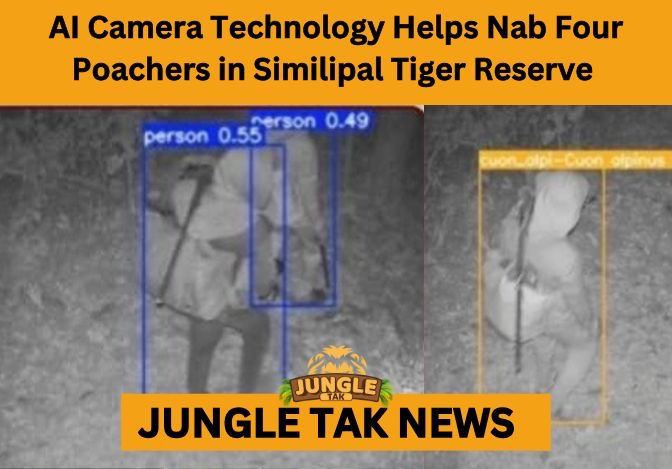

In a landmark achievement for tech-driven conservation, the Similipal Tiger Reserve (STR) authorities successfully apprehended four poachers who had illegally entered the protected forest area. This breakthrough was made possible through the state-of-the-art AI camera technology recently deployed across the reserve’s most vulnerable zones. The system, which is designed to distinguish between animal movements and human intrusions, provided forest officials with the critical lead needed to intercept the suspects before they could harm the local wildlife.
Real-Time Detection in the Deep Forest
The incident occurred in the core area of the reserve, where dense foliage often makes manual patrolling difficult. According to forest officials, the AI camera technology captured high-definition images of the four individuals carrying traditional hunting weapons and snares. Within seconds of the detection, the software transmitted a high-priority alert to the central control room, complete with GPS coordinates. This rapid relay of information via AI camera technology allowed the rapid response team to move in with surgical precision, catching the poachers completely off guard.
How the Smart Surveillance Works
Unlike traditional camera traps that simply record footage for later retrieval, the AI camera technology used in Similipal operates on an “edge-computing” framework. This means the cameras are equipped with internal processors that analyze images in real-time, filtering out “noise” like swaying branches or passing herbivores. When the AI camera technology identifies a human silhouette or a firearm, it utilizes satellite or long-range radio frequencies to send an instant notification to rangers. This proactive capability of AI camera technology has effectively turned the forest into a “living” security grid that never sleeps.
Protecting the Rare Melanistic Tigers
The deployment of AI camera technology is particularly crucial for Similipal, as it is the world’s only natural habitat for the rare melanistic (black-striped) Bengal tigers. These unique big cats are a primary target for international poaching syndicates, making their protection a matter of global conservation priority. By integrating AI camera technology into the reserve’s security protocol, the Odisha Forest Department is creating a formidable digital barrier that discourages intruders and ensures a safer breeding ground for these genetically distinct tigers.
Strengthening the Hands of Forest Guards
While the role of human intelligence and foot patrolling remains irreplaceable, the addition of AI camera technology serves as a massive force multiplier for the ground staff. Forest guards often face life-threatening situations when confronting armed poachers in the dark. With the predictive data provided by AI camera technology, patrol teams can now plan their interventions more safely, knowing the exact number of intruders and the nature of their weapons. This synergy between brave field officers and AI camera technology is redefining the standards of wildlife law enforcement in India.
Legal Proceedings and Evidence Gathering
Following the arrest, the forest department seized a variety of hunting gear, including bows, arrows, and traps, from the four suspects. The digital evidence produced by the AI camera technology is expected to play a vital role in the judicial process, providing undeniable proof of the suspects’ presence in the restricted core zone. Because the AI camera technology records timestamped, high-resolution metadata, it creates a robust paper trail that makes it significantly harder for poachers to evade conviction in a court of law.
Expanding the Tech Footprint in Odisha
The success of this recent operation has prompted calls for the expansion of AI camera technology to other sensitive wildlife corridors across Odisha, such as Bhitarkanika and Satkosia. Conservationists argue that as poaching methods become more sophisticated, the defense mechanisms must evolve accordingly. The investment in AI camera technology is proving to be a cost-effective solution in the long run, as it reduces the reliance on massive manpower while increasing the success rate of interceptions and preventing wildlife crimes before they occur.
CONTINUE READING WITH JUNGLETAK – GUARDIANS OF THE HEIGHTS
A Future Defined by Tech-Driven Conservation
As the four poachers face strict charges under the Wildlife Protection Act, the Similipal Tiger Reserve stands as a beacon of hope for other sanctuaries struggling with illegal hunting. The integration of AI camera technology has proven that modern science can be the greatest ally of nature. Moving forward, the continued refinement of AI camera technology will be essential in ensuring that the roar of the tiger continues to echo through the forests of Odisha, safe from the shadow of the poacher’s snare. The victory in Similipal is a clear message: with AI camera technology, the forest is always watching.