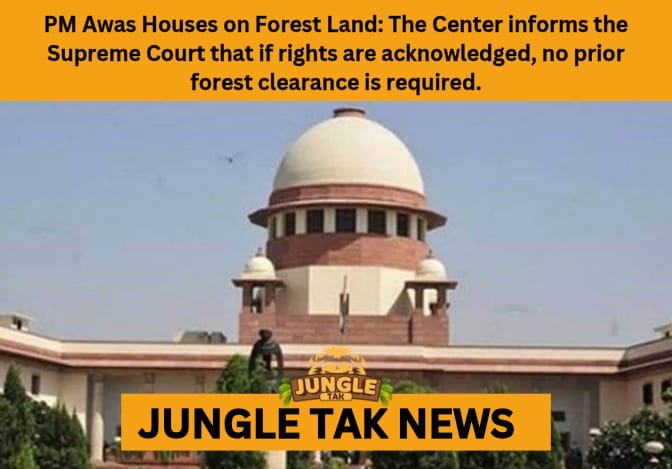

The Construction of PM Awas houses on forest land
In a landmark submission to the Supreme Court, the Central Government has clarified its stance on the construction of PM Awas houses on forest land. The Ministry informed the apex court that if the rights of forest dwellers are already acknowledged under the Forest Rights Act (FRA) of 2006, there is no legal requirement to seek prior forest clearance under the Forest Conservation Act (FCA). This announcement is expected to remove major hurdles for thousands of tribal families who have been awaiting permanent shelter but were stuck in a jurisdictional tug-of-war between housing and forest departments.
The debate surrounding the legality of PM Awas houses on forest land stems from the complex intersection of housing rights and environmental conservation laws. Traditionally, any non-forest activity on forest land—including building a permanent residence—required a rigorous and often multi-year clearance process from the Ministry of Environment, Forest, and Climate Change. However, the Center’s recent clarification suggests that once an individual’s or community’s right to the land is legally recognized under the FRA, that land is designated for the dweller’s use, effectively allowing for the development of essential infrastructure like housing.
During the proceedings, the bench examined how the Recognition of Forest Rights Act (FRA) interacts with the Forest Conservation Act (FCA) specifically regarding PM Awas houses on forest land. The government’s legal counsel argued that the FRA is a self-contained code designed to undo “historical injustices” faced by forest-dwelling communities. Therefore, requiring a secondary forest clearance for a house on a plot where a tribal family already holds a legal title would be redundant and would contradict the primary goal of the FRA, which is to provide land and life security to the marginalized.
This legal interpretation is viewed as a major victory for the Ministry of Rural Development, which oversees the implementation of PM Awas houses on forest land across the country. By bypassing the lengthy prior clearance process, the government can significantly expedite the disbursement of funds and the commencement of construction. This move is particularly beneficial in hilly and forested regions, such as parts of Jharkhand, Chhattisgarh, and the Western Ghats, where private land is scarce and most inhabitants reside on traditional forest tracts.
For the tribal populations of India, the ability to build PM Awas houses on forest land without bureaucratic delays is a matter of dignity and survival. Many families have lived in temporary, unsafe shacks for generations due to the fear of eviction or the inability to obtain municipal construction permits on forest-designated territory. With the Center’s confirmation to the Supreme Court, these residents can now transition to “pucca” (permanent) houses with the full backing of the law, provided their forest rights are officially registered and verified.
While the focus remains on rural development, the Center maintained that the construction of PM Awas houses on forest land does not grant a “free pass” to destroy the local environment. The government clarified that the houses must be built strictly on the specific land parcels for which individual or community rights have been formally granted. This ensures that while human welfare is prioritized, the broader forest cover remains protected from unauthorized encroachment or commercial exploitation that falls outside the scope of recognized tribal rights.
State governments and local district collectors have often been hesitant to approve the construction of PM Awas houses on forest land due to the looming threat of litigation or environmental penalties. This clear directive from the Central Government to the Supreme Court provides the necessary administrative protection for local officials. It empowers them to process housing applications with greater confidence, knowing that the lack of a formal forest clearance will not result in legal repercussions as long as valid FRA titles are in place.
The relaxation of rules for PM Awas houses on forest land also paves the way for better convergence of other essential government services. When a house is legally recognized on forest land, it becomes much easier for utility departments to provide associated infrastructure, such as domestic electricity connections, piped water supply, and sanitation facilities under the Swachh Bharat Mission. This holistic approach ensures that forest-dwelling communities are integrated into the national development narrative without being displaced from their ancestral landscapes.
As the Supreme Court takes note of this submission, the focus will now shift toward ensuring that the identification of beneficiaries for PM Awas houses on forest land is done with absolute transparency. The government must ensure that only genuine forest dwellers with valid, verified titles benefit from this clearance exemption. Strengthening the role of Gram Sabhas (village councils) in verifying these claims will be crucial to preventing the misuse of this policy by land mafias while fulfilling the constitutional promise of “Housing for All.”
CONTINUE READING WITH JUNGLETAK – ILLEGAL ARAVALLI BOREWELL DRILLING
In conclusion, the Center’s statement marks a significant shift in the legal landscape governing PM Awas houses on forest land. By prioritizing the Forest Rights Act over the procedural requirements of the Forest Conservation Act in these specific social welfare cases, the government is making a bold statement on social justice. This move ensures that the most marginalized citizens of the country are no longer denied the basic human right to shelter due to overlapping and contradictory environmental regulations.