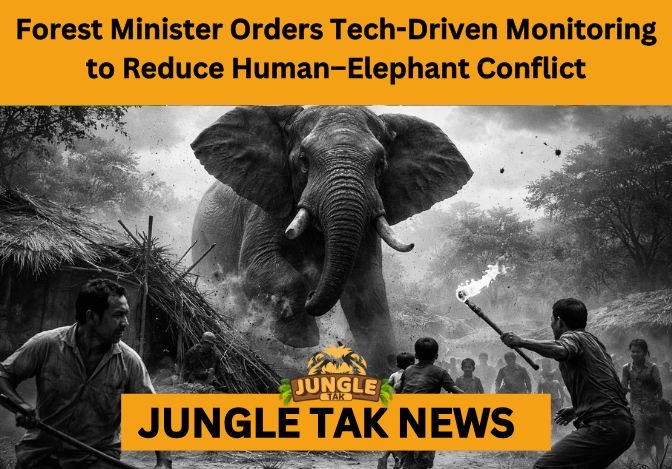

Issue of human-elephant conflict in Chikkamagaluru
The persistent issue of human-elephant conflict in Chikkamagaluru has reached a critical turning point as the Karnataka state government pivots toward a technology-first approach. During a recent high-level meeting and field visit to the district, Forest Minister Ishwar Khandre issued stern directives to the Forest Department to implement advanced monitoring systems. The move comes as a response to the increasing frequency of elephant straying into coffee plantations and residential areas, which has heightened the urgency to mitigate the human-elephant conflict in Chikkamagaluru.
For decades, the Malnad region has been a hotspot for wildlife-human interactions, but recent years have seen a spike in casualties and property damage. Recognizing the gravity of the situation, the Minister emphasized that traditional methods of patrolling are no longer sufficient to manage the human-elephant conflict in Chikkamagaluru. By integrating Artificial Intelligence (AI) and thermal imaging, the department aims to create a virtual fence that can alert authorities before a herd enters human settlements.
The core of this new initiative involves the deployment of high-end drones equipped with infrared sensors to track elephant movements in real-time. This tech-driven surveillance is expected to provide the Forest Department with a tactical advantage in predicting migration patterns, thereby reducing the risk of human-elephant conflict in Chikkamagaluru. These drones will be particularly useful in the dense canopy of the Western Ghats, where visual tracking by ground staff is often hindered by the rugged terrain.
In addition to aerial surveillance, the Minister has ordered the installation of AI-powered camera traps at known entry points where elephants exit forest boundaries. These cameras are designed to automatically identify elephant silhouettes and send instant SMS alerts to local villagers and forest guards. This early warning system is a vital component in the strategy to minimize the human-elephant conflict in Chikkamagaluru, giving residents enough time to secure their property and avoid dangerous encounters.
Furthermore, the Forest Department has been instructed to expedite the radio-collaring of “rogue” or frequent-straying elephants. By monitoring the GPS coordinates of these specific animals, officials can establish a “geofence” that triggers alarms whenever an elephant crosses a certain perimeter. This proactive tracking is seen as a sustainable way to handle the human-elephant conflict in Chikkamagaluru, ensuring that the movement of herds is monitored 24/7 without constant human interference.
Minister Ishwar Khandre also addressed the structural aspects of the problem, calling for the completion of rail-track barricades in high-risk zones. While technology plays a major role, physical barriers remain a necessary deterrent to prevent pachyderms from entering agricultural lands. The combination of digital monitoring and physical infrastructure is intended to provide a comprehensive shield against the human-elephant conflict in Chikkamagaluru, protecting both the livelihoods of farmers and the lives of the majestic animals.
To ensure the success of these measures, the Minister highlighted the need for a dedicated control room in the district. This central hub will process all data from drones, cameras, and GPS collars to coordinate rapid-response teams. By streamlining communication, the department can react within minutes to any reports of a brewing human-elephant conflict in Chikkamagaluru, significantly lowering the chances of a fatal confrontation between man and beast.
Local community involvement was another key highlight of the Minister’s order. The “Elephant Task Force” will be expanded and equipped with better communication tools to work alongside the tech systems. The government believes that involving the local youth in tech-based monitoring will foster a sense of ownership and improve the efficiency of interventions aimed at ending the human-elephant conflict in Chikkamagaluru.
Crop compensation processes are also being digitized to ensure that farmers who suffer losses receive financial aid without bureaucratic delays. The Minister noted that frustration among the farming community often leads to retaliatory measures against wildlife, which further complicates the human-elephant conflict in Chikkamagaluru. By providing swift relief and using technology to prevent future damage, the government hopes to restore trust between the forest officials and the public.
As the tech-driven monitoring systems roll out, Chikkamagaluru is set to become a model for wildlife management in India. The integration of modern science into conservation efforts marks a new era in how the state handles the human-elephant conflict in Chikkamagaluru. The Minister’s focus on innovation suggests that while the challenges of the Malnad region are great, they are not insurmountable with the right tools.
CONTINUE READING WITH JUNGLETAK – KARNATAKA REOPENS WILDLIFE SAFARIS
Ultimately, the goal is to create a landscape where both humans and elephants can coexist with minimal friction. The Forest Minister’s directive for tech-driven monitoring is a bold step toward a future where “conflict” is replaced by “cohabitation.” Through these advanced measures, the state remains committed to resolving the human-elephant conflict in Chikkamagaluru while preserving the ecological integrity of the Western Ghats.