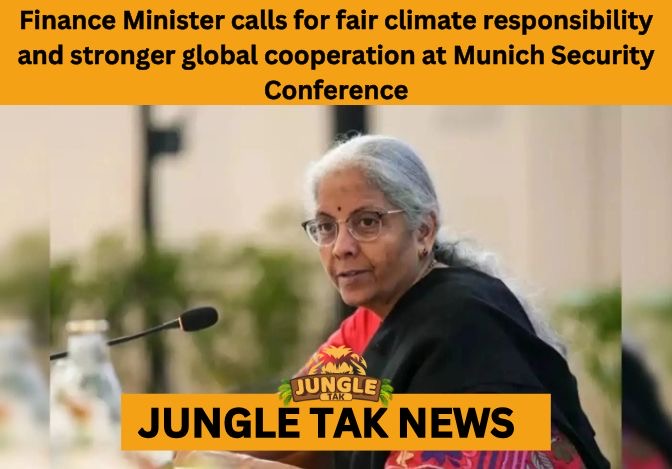

At the prestigious Munich Security Conference, the Finance Minister delivered a powerful address emphasizing that the escalating environmental crisis requires a renewed and equitable sense of global climate responsibility. Speaking to an audience of world leaders, defense experts, and high-level diplomats, the Minister highlighted that climate change is no longer a peripheral environmental concern but a core component of international security. The speech underscored that without a unified and fair approach to sustainability, the world risks entering an era of unprecedented resource conflict and geopolitical instability.
The core of the Minister’s message was a demand for “climate justice,” arguing that global climate responsibility must be distributed based on historical contributions to carbon emissions. The Finance Minister noted that while emerging economies are eager to transition to green energy, they must not be unfairly penalized for the industrial legacies of the developed world. This call for a “common but differentiated” approach serves as a reminder that the path to a net-zero future must be paved with fairness, ensuring that developing nations can pursue economic growth alongside environmental goals.
Linking Climate Resilience to International Security
A significant portion of the discourse focused on how a lack of global climate responsibility acts as a “threat multiplier” in vulnerable regions. The Finance Minister pointed out that extreme weather events, such as prolonged droughts and catastrophic flooding, lead to large-scale displacement and competition over dwindling food and water supplies. By reframing climate change as a security imperative, the Minister urged the Munich Security Conference attendees to view investments in green infrastructure as a vital strategy for preventing future wars and migration crises.
To address these looming threats, the Finance Minister called for a massive overhaul of the current international financial architecture to better support global climate responsibility. The Minister criticized the consistent delay in fulfilling the $100 billion annual climate finance promise made by developed nations to the Global South. It was argued that without predictable and affordable financing, the global community cannot expect developing countries to abandon fossil fuels rapidly, as the cost of capital for renewable projects remains prohibitively high in many parts of the world.
Reforming Global Finance and Technology Transfer
Beyond mere financial aid, the Finance Minister stressed that global climate responsibility involves the uninhibited transfer of green technologies from the West to the rest of the world. The speech advocated for a more collaborative patent regime that allows for the localized manufacturing of solar panels, wind turbines, and green hydrogen technology. By democratizing the tools of the energy transition, the Minister believes the world can achieve a much faster and more comprehensive reduction in global carbon footprints than by relying on market forces alone.
Furthermore, the Minister suggested that multilateral development banks must pivot their lending priorities to align with the demands of global climate responsibility. The current system, which often traps developing nations in high-interest debt, is seen as a barrier to effective climate adaptation. The Finance Minister proposed new “green credit” mechanisms and risk-sharing facilities that would incentivize private sector investment in the Global South, turning climate challenges into opportunities for sustainable industrialization.
The Role of Diplomacy in Environmental Preservation
During the high-level panels, the Minister reiterated that the Munich Security Conference provides a unique platform to forge a new consensus on global climate responsibility. The Minister urged the international community to move past rhetoric and engage in “action-oriented diplomacy.” This involves creating transparent monitoring systems to ensure that climate commitments are not just empty promises but are backed by verifiable domestic policy changes and international cooperation agreements.
In concluding the address, the Finance Minister reminded the assembly that the weight of global climate responsibility rests on the shoulders of this generation of leaders. The speech was a clarion call for the world’s most powerful economies to lead by example, demonstrating that security and sustainability are two sides of the same coin. As the conference wrapped up, the message remained clear: only through a fair, cooperative, and financially supported global strategy can we hope to secure a stable planet for future generations.
CONTINUE READING WITH JUNGLETAK – UTTAR PRADESH GREEN INITIATIVE PUSH
Future Outlook for Global Cooperation
Ultimately, the Finance Minister’s participation in the Munich Security Conference has set a high bar for upcoming environmental summits. By centering the conversation on global climate responsibility, the Minister has forced a necessary dialogue on the ethics of the green transition. Moving forward, the success of international climate policy will be measured not just by the reduction of greenhouse gases, but by the level of trust and equity established between the world’s wealthiest and most vulnerable nations.