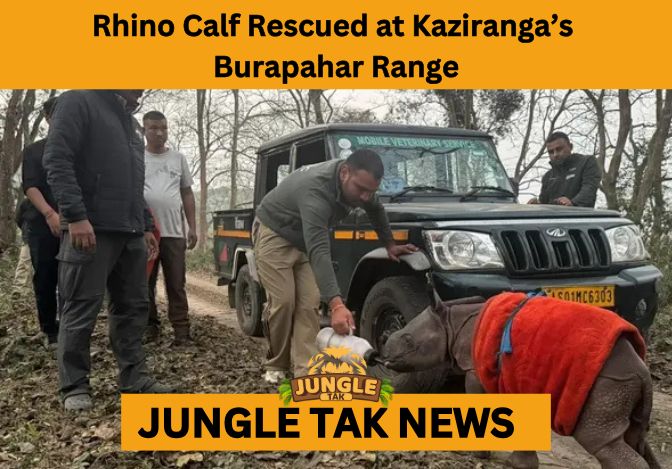

The mist over the Brahmaputra usually brings a sense of calm to the plains of Assam, but for the forest guards of the Burapahar range, the morning of January 21 was filled with urgent tension. In a heart-wrenching yet triumphant display of wildlife conservation, a male rhino calf rescued at Kaziranga has become the latest symbol of hope for the state’s biodiversity. This operation, involving drones, elephants, and a team of dedicated conservationists, underscores the relentless efforts of the Kaziranga National Park and Tiger Reserve (KNP&TR) team in protecting the endangered greater one-horned rhinoceros.
The Discovery in the Sarali Area
The drama began late Wednesday evening when frontline staff on routine patrol spotted a lone, small figure moving aimlessly near the Sarali area. It was immediately identified as a young male, barely a few months old, separated from its mother. The news of the rhino calf rescued at Kaziranga spread quickly through the administrative channels, prompting the Divisional Forest Officer (DFO) of the Eastern Assam Wildlife Division to initiate an immediate emergency protocol. In the wild, a calf of this age is highly vulnerable to predators, particularly the Bengal tigers that roam the Burapahar range, making every second of the operation critical.
A Tense 24-Hour Search Mission
Wildlife protocol dictates that a calf should only be removed from the wild as a last resort. Therefore, the primary goal for the first 24 hours was to locate the mother and facilitate a natural reunion. To ensure the rhino calf rescued at Kaziranga had the best chance of returning to its mother, the forest department deployed a sophisticated search party. For an entire day and night, the Burapahar range became a hive of activity, with officials balancing the need for a thorough search with the need to keep the calf safe from lurking threats.
Advanced Technology Meets Traditional Tracking
The search effort was a masterclass in modern conservation techniques. To track the elusive mother through the tall elephant grass and dense thickets, the team utilized departmental elephants—the traditional “all-terrain vehicles” of the jungle. Simultaneously, the mission to ensure the rhino calf rescued at Kaziranga was reunited with its kin saw the deployment of high-tech thermal drones. These “eyes in the sky” scanned the landscape for the heat signatures of a large adult female, but despite sweeping the Sarali area and its peripheries, no sign of the mother was found.
Expert Veterinary Care on the Frontlines
While the search continued, the physical health of the young animal was the top priority for the park’s medical team. A specialized group of veterinarians, including Dr. Bhaskar Choudhury, Dr. Mohit Nyol, and Dr. Saurobh Borgohain, remained stationed near the site. The rhino calf rescued at Kaziranga required constant observation to monitor its stress levels and hydration. The presence of these experts ensured that the calf did not succumb to “capture myopathy” or exhaustion while the forest guards maintained a protective perimeter around the site.
The Difficult Decision to Intervene
By Thursday afternoon, the window of opportunity for a natural reunion began to close. With no sightings of the mother and the calf showing signs of increasing distress and hunger, the DFO and the Field Director of KNP&TR, Dr. Sonali Ghosh, made the executive call to move the animal. The rhino calf rescued at Kaziranga was officially taken into custody at approximately 4:00 PM on Thursday. This decision was rooted in the “best interest of the animal” policy, recognizing that a night alone in the predator-heavy Burapahar range would likely have been fatal.
Transportation to the CWRC
Moving a rhino, even a calf, is a logistical challenge that requires immense care and specialized equipment. The rhino calf rescued at Kaziranga was carefully secured and transported to the Centre for Wildlife Rehabilitation and Conservation (CWRC) at Panbari/Borjuli. This facility is a globally recognized hub for animal welfare, operated as a joint venture between the Assam Forest Department, the Wildlife Trust of India (WTI), and the International Fund for Animal Welfare (IFAW). The calf’s journey from the rugged terrain of Burapahar to the controlled environment of the CWRC marked the beginning of its long road to recovery.
A New Chapter at the Rehabilitation Centre
Upon arrival at the CWRC, the calf was placed in a specialized nursery designed to mimic its natural habitat while providing the medical intervention it needs. For the rhino calf rescued at Kaziranga, the coming weeks will involve a strict diet of milk formula and constant companionship from experienced animal keepers. These keepers act as surrogate mothers, providing the emotional security that young rhinos—highly social and sensitive creatures—require to thrive in captivity before they can eventually be returned to the wild.
The Legacy of Conservation in Assam
This successful operation is a testament to the robust conservation infrastructure built in Assam over the last few decades. The rhino calf rescued at Kaziranga is one of thousands of animals that have passed through the doors of the CWRC, a center that has handled over 7,300 rescues across 350 different species. The goal of the center is never permanent captivity; rather, it is a “release-oriented” facility. Most rhinos raised here are eventually translocated to protected areas like Manas National Park, contributing to the “Vision 2020” and beyond goals of expanding the rhino’s range.
The Challenges of the Burapahar Range
The Burapahar range, where the calf was found, is known for its undulating terrain and serves as a vital corridor for wildlife moving toward the Karbi Anglong hills. The fact that the rhino calf rescued at Kaziranga was found in this specific area highlights the importance of maintaining safe corridors for wildlife. During the monsoon or during periods of territorial shifts, calves often get separated from their mothers in these hilly transition zones. The alertness of the Burapahar forest guards is what ultimately prevented this incident from becoming a tragedy.
Looking Toward a Sustainable Future
As the calf begins its rehabilitation, the incident serves as a reminder of the delicate balance within the Kaziranga ecosystem. Every rhino calf rescued at Kaziranga represents a significant investment in the future of the species, which was once on the brink of extinction. Today, with the population of the greater one-horned rhino exceeding 2,600 in the park alone, these individual rescue stories are the building blocks of a global conservation success story that continues to inspire environmentalists worldwide.
CONTINUE READING WITH JUNGLETAK – MUTILATED ELEPHANT REMAINS
A Community Effort
The story of the male rhino calf rescued at Kaziranga is not just a story of a single animal, but a narrative of human dedication and scientific excellence. From the guards who first spotted him to the pilots of the drones and the vets at the CWRC, a massive network of professionals worked in harmony to save one life. As this young rhino grows stronger in the safety of the rehabilitation center, he stands as a living testament to Assam’s commitment to “Prakriti Rakshati Rakshita”—Nature protects those who protect it.