
The Presence of the IIT-Bombay crocodile
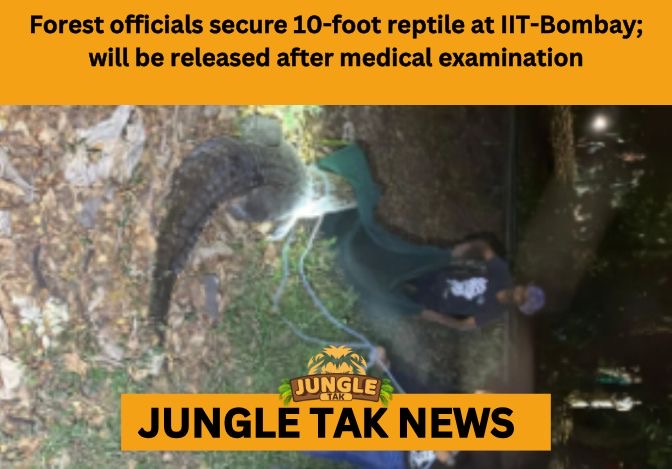
The prestigious Indian Institute of Technology Bombay (IIT-B) recently became the site of a major wildlife operation when a massive reptile was spotted wandering within its sprawling campus. Onlookers were stunned to find a 10-foot-long marsh crocodile, commonly known as a Mugger, resting near one of the residential areas of the institute. The presence of the IIT-Bombay crocodile immediately prompted a swift response from the Maharashtra Forest Department and local wildlife experts to ensure the safety of both the students and the animal.
The sighting occurred during the early hours, sparking a mixture of awe and concern among the campus community. Because the campus is nestled right next to the crocodile-infested Powai Lake, it is not entirely uncommon for wildlife to stray beyond the water’s edge. However, the sheer size of this particular IIT-Bombay crocodile made it a priority for rescue, as a reptile of that magnitude could pose a significant risk if left unattended in a high-traffic human zone.
Forest department officials, along with volunteers from local wildlife NGOs, arrived promptly at the scene to initiate the capture. Securing a 10-foot predator requires immense precision and care to prevent the animal from sustaining injuries or becoming overly stressed. The rescue team successfully tranquilized and restrained the IIT-Bombay crocodile, moving it into a specialized transport cage designed for heavy reptiles.
Preliminary observations by the rescue team indicated that the animal was a mature adult in relatively good physical condition. While marsh crocodiles are known to inhabit the adjacent Powai Lake, this IIT-Bombay crocodile had managed to travel quite a distance into the academic and residential corridors. Experts believe that the recent heavy rains or a search for a new basking spot might have driven the reptile further inland than usual.
Following the successful capture, the forest department announced that the IIT-Bombay crocodile would not be released immediately. Per standard operating procedures for urban wildlife rescues, the reptile was transported to a temporary holding facility. Here, the IIT-Bombay crocodile is undergoing a thorough medical examination to ensure it is free from infections, injuries, or any signs of lethargy that could hinder its survival in the wild.
A team of specialized veterinarians is conducting a “fitness for release” check-up on the reptile. This process involves checking the animal’s reflexes, respiratory health, and skin condition. If the IIT-Bombay crocodile passes these health markers, it will be microchipped for future identification and monitoring. This data is vital for researchers who track the movement patterns of crocodiles in the Mumbai metropolitan region.
The incident has reignited discussions regarding the proximity of the IIT-B campus to natural wildlife habitats. Since the campus shares a boundary with a lake that is a natural breeding ground for Muggers, the appearance of an IIT-Bombay crocodile serves as a stark reminder of the delicate balance between urban infrastructure and the natural world. Campus authorities often issue advisories, but a 10-foot visitor is a rare occurrence that necessitates heightened vigilance.
Local environmentalists argue that as Powai Lake faces challenges like pollution and encroachment, the reptiles are forced to find alternative spaces. The rescue of this IIT-Bombay crocodile highlights the need for better fencing and habitat restoration to keep the wildlife within the lake’s boundaries. By maintaining the health of the lake, the frequency of such human-wildlife encounters can be significantly reduced.
Once the medical team provides a “fit” certificate, the forest department will coordinate the release of the IIT-Bombay crocodile into a suitable, secluded habitat. This release usually happens under the cover of night in a location far from human settlements to ensure the animal can reintegrate into the ecosystem without further conflict. The department emphasizes that the goal is always the welfare of the IIT-Bombay crocodile while prioritizing public safety.
CONTINUE READING WITH JUNGLETAK – TRAGIC LEOPARD ATTACK
In conclusion, the successful rescue of the 10-foot reptile at one of India’s most famous engineering colleges is a testament to the efficiency of Mumbai’s wildlife responders. While the students return to their labs and classrooms, the story of the IIT-Bombay crocodile remains a fascinating chapter in the institute’s history. It serves as a powerful example of how urban centers can coexist with ancient predators through professional management and scientific care.